


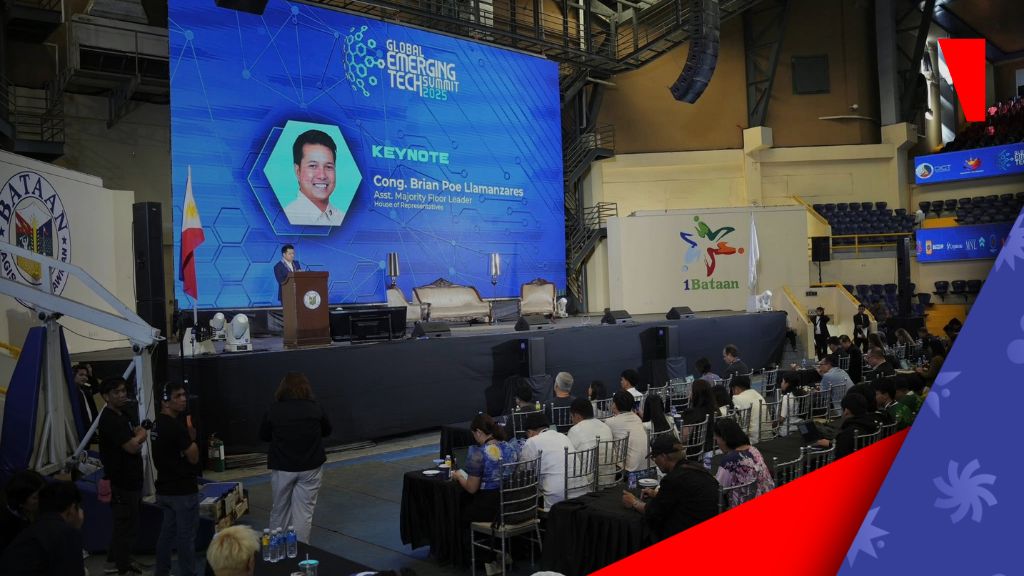
FPJ Panday Bayanihan Partylist Representative and House Assistant Majority Leader Brian Poe Llamanzares is pushing House Bill No. 1196 or the Philippine Artificial Intelligence Governance Act, which proposes the creation of the Artificial Intelligence Development Authority (AIDA) under the Department of Science and Technology.
“AIDA will serve as a national champion for ethical AI, responsible for drafting our comprehensive national AI strategy and representing the Philippines in global policy corridors,” Llamanzares said during his keynote speech at the Global Emerging Tech Summit held in Balanga City, Bataan.
The bill establishes a risk-based classification system to prevent AI applications that violate human rights. It also mandates strict auditing and data governance rules for high-risk AI systems, especially those used in law enforcement, healthcare, and electoral processes in the country. The lawmaker said that a regulatory sandbox will also allow startups and researchers to test AI solutions in controlled environments, ensuring that regulation encourages innovation rather than suppressing it.
AI at the centre of a global shift
Llamanzares said the world is experiencing an age of exceptional change, with AI, blockchain, and quantum technologies now reshaping society. “AI has moved from academic theory to a pervasive force, automating complex decisions and profoundly influencing the very mechanics of our democracy and governance,” he said.
“For every new tool that empowers, another can be used to exploit through sophisticated deep fake scams. Every algorithm that enlightens another can entrench existing social and racial biases,” Llamanzares said. The central issue, he stressed, is not whether the country will adopt emerging technologies but how it will govern them.
AI and governance
Llamanzares said the Filipino spirit of “bayanihan” must evolve to meet the realities of a rapidly changing technological environment. “It’s a collective and courageous action driven by solidarity, placing the needs of the community above oneself.”
He said this same principle must guide the country’s approach to digital transformation. “Our prosperity in this new era will depend on our ability to lift each other, not by carrying our hopes on our backs, but [by] carrying ideas and opportunities.” Digital progress, he added, must be rooted in trust, guided by ethics, and secured by law.
Preparing workers for the age of automation
The Philippine lawmaker acknowledged that technological advancement will displace some jobs, particularly in sectors vulnerable to automation. He cited House Bill No. 2766, the Career Transition Assistance Act, as a key measure to support affected workers. The bill mandates free reskilling and upskilling through the Technical Education and Skills Development Authority (TESDA) and the Department of Labour and Employment (DOLE), with training centred on cybersecurity, data analytics, and other high-growth fields. It also offers wage subsidies and career counselling to help workers transition into new roles.
The FPJ Panday Bayanihan Partylist Representative emphasised that the success of emerging technologies must ultimately be measured in terms of social impact. “It is not in terabytes of data or market capitalisation of our latest unicorns. It is not in how many algorithms we deploy, but in how many Filipinos’ lives we improve, empower, and uplift,” Llamanzares concluded.
Be part of the action at SiGMA South Asia, 30 Nov – 02 Dec 2025. Colombo becomes the heart of gaming as 5,000 delegates, 100+ speakers, and 1,000 operators gather under one roof. With high-value traffic, game-changing insights, and unforgettable networking, this is where new markets meet new horizons.


