
Game Theory in Gambling? A Complete Guide with Examples

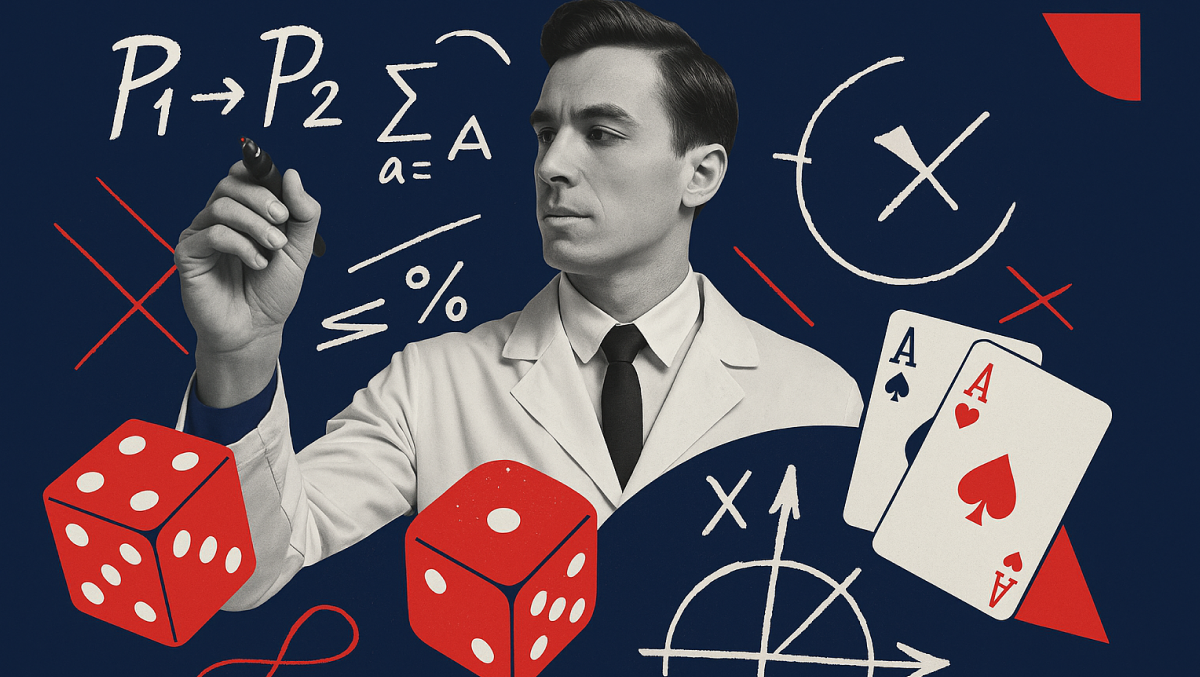
Game theory is the study of how individuals, companies, or countries approach strategic decision-making when the outcome depends on other players as well. So, what is gaming theory in real life? Deciding on a route to work, your call in poker, or negotiating a deal: these are all valid game theory examples.
If this makes you think of game theory as a way to improve decision-making, then you’re on the right track. In this article, we’ll give you a complete understanding of the concept. We’ll cover the types of game theory situations in detail, the best game theory definition you should work with, and its applications in the world of gambling and sports betting.
Game Theory Definition: A Simple Explanation
Game theory has its origins in economics, mathematics, and psychology. The working idea behind it is simple: whenever you’re in a system with other participants, the outcome you expect will depend upon what choices other players make as well.
Classical game theory always supposes that the player, as well as other decision-makers in the system, are always rational. However, the question of “What is game theory?” changes a little bit in behavioral psychology, a field where game theory is about how players will actually make a decision in the real world, where they are influenced by emotion, bias, or limited information.
Game theory examples come from all sorts of fields, including computer science, business, sports, and even gambling. It serves as a framework for analyzing situations where the outcomes depend not only on one’s actions but also on the actions of others.
Key Terms in Game Theory
Before we jump into the types of game theory scenarios or their core examples, it’s important to talk about the recurring terms related to the topic. Here are some terms that are fundamental to understanding the core concepts.
- Player: A player is any decision-maker in a game. It could be an individual, a company, a country, a sports team, or any entity that has a strategic choice to make.
- Game: A game is any scenario where every outcome made by any given player depends on what other participants choose as well.
- Strategy: The plan of action chosen by any player is a strategy. For instance, an investor employs a strategy of buying up a significant share of a stock to move market sentiment.
- Payoff: This is the result that any given outcome carries. Outcomes are objective in game theory, so any situation can be seen as profit, loss, victory, safety, gain in reputation, and more, depending on its nature.
- Rationality: It’s the calculated assumption that, based on the available information, there’s an option that yields the best possible outcome.
- Dominant Strategy: While a strategy is a simple plan of action, a dominant strategy is the best possible course of action, regardless of what choices other players make.
- Nash Equilibrium: One of the most fundamental concepts for understanding what is game theory, a Nash Equilibrium is a situation where there’s no incentive for all players in a game to switch up their initial strategy.
- Cooperation: Cooperating is a useful concept when there’s an incentive for players to start working together for common gain.
- Defection: While cooperating helps every single player, defection is when a player chooses a different strategy out of self-interest.
A Brief History of Game Theory
If you’d go back long enough to find a game theory definition, odds are, you would come up empty-handed. That’s because game theory came from the interaction of many fields, such as military strategy, mathematics, politics, and more.
It was in the 1800s when its early ideas became popular, as the French philosopher and mathematician Antoine Augustin Cournot published his study on how competing firms choose outputs. In the early 1900s, mathematicians such as Ernst Zermelo and Émile Borel began studying strategic games, but the question of what game theory is was properly raised in 1944 by an economist and a mathematician pair.
Oskar Morgenstern and John von Neumann established the field by publishing Theory of Games and Economic Behavior. This treatise showed how mathematics was useful in the study of conflict, bargaining, cooperation, and competition. In the 1950s, American mathematician John Nash laid the foundation of the Nash equilibrium, and later thinkers such as Thomas Schelling, John Harsanyi, Reinhard Selten, and Robert Aumann showed how game theory also applied to war, auctions, markets, diplomacy, and even social behavior.
Main Types of Game Theory
Game theory is broad, but there are some rules that apply to all sorts of scenarios. Take a look at several types of game theory scenarios, where some situations are competitive, cooperative, or a mix of the two.
Cooperative vs. Non-Cooperative Games
In cooperative games, players have a real incentive to collaborate, form agreements, make alliances, or enter coalitions. This strategy benefits all the players with divided rewards, and trust between parties is paramount for games to stay cooperative.
The exact opposite is a non-cooperative game, where every party opts for a strategy that works best for them. While it’s not necessary that all players are hostile towards each other, there’s no agreement in place either. The best example of this is two rival companies independently controlling the price of their product.
| Company B Keeps Price High | Company B Cuts Price | |
|---|---|---|
| Company A Keeps Price High | 4, 4 | 1, 5 |
| Company A Cuts Price | 5, 1 | 2, 2 |
Zero-Sum vs. Non-Zero-Sum Games
A zero-sum game is a situation where gain and loss are directly proportional between parties. If one player ends up winning, the other player will lose out on the same amount. Boxing, chess, or any other one-vs-one match is the best example of zero-sum games.
| Black Plays Aggressively | Black Plays Defensively | |
|---|---|---|
| White Plays Aggressively | 0, 0 | 1, -1 |
| White Plays Defensively | -1, 1 | 0, 0 |
In a non-zero-sum game, on the other hand, both players have the room to win, lose, or collaborate. Trade deals between nations and business negotiations between companies are key examples of game theory scenarios that are classified as a non-zero-sum game.
| Country B Opens Trade | Country B Keeps Trade Barriers | |
|---|---|---|
| Country A Opens Trade | 6, 6 | 2, 7 |
| Country A Keeps Trade Barriers | 7, 2 | 3, 3 |
Simultaneous vs. Sequential Games
Simultaneous games entail players making their decisions without any knowledge of what the other player has chosen. The Prisoner’s Dilemma is among the key examples of game theory scenarios where the game is simultaneous.
| Prisoner B Stays Silent | Prisoner B Confesses | |
|---|---|---|
| Prisoner A Stays Silent | 3, 3 | 0, 5 |
| Prisoner A Confesses | 5, 0 | 1, 1 |
Sequential games, as the name suggests, occur when one player makes a move in response. Chess, military situations, and job offer negotiations are all sequential games, as they all require a response after the first move.
| Candidate Accepts Offer | Candidate Rejects Offer | |
|---|---|---|
| Employer Offers High Salary | 3, 4 | 0, 1 |
| Employer Offers Low Salary | 5, 2 | 1, 1 |
Symmetric vs. Asymmetric Games
In symmetric games, the conditions and primary strategy remain the same for each player. Examples of game theory scenarios for these games include a Game of Chicken (snowdrift) or Rock, Paper, Scissors.
| Player B Chooses Rock | Player B Chooses Paper | Player B Chooses Scissors | |
|---|---|---|---|
| Player A Chooses Rock | 0, 0 | -1, 1 | 1, -1 |
| Player A Chooses Paper | 1, -1 | 0, 0 | -1, 1 |
| Player A Chooses Scissors | -1, 1 | 1, -1 | 0, 0 |
Asymmetric games feature players who all play different roles, have different options and information, and operate with different levels of power. Many situations in the real world are asymmetric, as larger entities like companies or governments enter a situation with equal resources or information. Job interviews and sales based on incomplete information are some examples of asymmetric games.
| Seller Discloses Car Issues | Seller Hides Car Issues | |
|---|---|---|
| Buyer Buys the Car | 4, 3 | 1, 5 |
| Buyer Walks Away | 2, 1 | 3, 0 |
Classic Game Theory Examples in Real Life
Understanding what is game theory becomes easier when we look at real-world situations instead of abstract definitions. There are some popular scenarios that are often brought up whenever game theory is discussed.
The Prisoner’s Dilemma
One of the most famous examples in game theory, The Prisoner’s Dilemma, is a simultaneous game where two players, each without the information of the other’s response, have to choose between cooperating or choosing their own self-interest.
Imagine an interrogation of two suspects being questioned, where if they stay silent, their punishment won’t be severe. However, if one chooses to stay silent and the other decides to act out of self-interest, the confessor gets the better deal. However, if both choose to confess, they both end up receiving a worse punishment than if they had both stayed silent.
| Prisoner B Stays Silent | Prisoner B Confesses | |
|---|---|---|
| Prisoner A Stays Silent | 3, 3 | 0, 5 |
| Prisoner A Confesses | 5, 0 | 1, 1 |
In real life, situations like this play out with price wars between two rival companies, workplace competition, and political negotiations.
The Ultimatum Game and Dictator Game
Fairness can be the great equalizer, which is what is at the center of The Ultimatum Game. Here, one player gets a sum of money, and they have to offer a part of it to another player. If the other player agrees to an amount, they both get the agreement. However, if the other player rejects the offer, both end up with nothing.
| Receiver Accepts | Receiver Rejects | |
|---|---|---|
| Proposer Makes Fair Offer | 3, 3 | 0, 0 |
| Proposer Makes Unfair Offer | 5, 1 | 0, 0 |
In the Dictator Game, the conditions stay the same, but the other player has no say in the matter. They must accept whatever the first person is given. Both the Dictator Game and the Ultimatum Game are two sides of the same coin, as one can approach tipping, salary negotiations, and charity in the same way, and the only difference between the two approaches is fairness and agency.
The Volunteer’s Dilemma
Imagine that you and your friends are in trouble with an authority figure. The entire group understands that one person trying to discuss the situation with the authority figure would help the entire group move past this situation. However, nobody wants to be a volunteer, because it comes with a potential cost. That’s essentially the Volunteer’s Dilemma, and something like a college project where one person has to do a difficult task is a key example of game theory regarding this dilemma.
| Person B Volunteers | Person B Does Not Volunteer | |
|---|---|---|
| Person A Volunteers | 3, 3 | 4, 5 |
| Person A Does Not Volunteer | 5, 4 | 0, 0 |
Game Theory in Economics and Business
All types of game theory are extremely relevant when it comes to scenarios in business and economics. According to the game theory definition, it is all about how players act within a system with other players, where their outcomes are affected by others as well. Thus, there are many situations where the likes of a product launch, a change in price of a product, a merger between two companies, or a trade deal between two nations all have economic and business implications. Here are some key examples of game theory scenarios in business and economics:
- A new company deciding which market to enter
- Advertising competition between two rival brands
- Negotiations between buyers and sellers
- Auctions for company contracts, property, and projects
- Trade partnerships between two companies in a joint venture
Game Theory Application in Gambling
Game theory can apply to various casino games, where players can strategize to get favorable outcomes. While game theory might not be useful when deciding how to pick winning lottery numbers, it is useful for understanding and predicting behaviors in gambling scenarios. Going by our game theory definition, let’s take a look at how it can be applied to some of the most popular casino games.
Poker and the Nash Equilibrium
Poker, unlike many casino games like slots, requires a fair bit of strategy on the player’s part. This is why game theory can help poker players, because players have to both account for the cards in their hands as well as anticipate what their opponents are holding to improve their chances as well.
Historically, poker players focused on experience and intuition, emphasizing the psychological aspects of “playing the player” rather than the cards themselves. However, the modern approach has been revolutionized after many types of game theory became popular.
Interestingly, one key connection between game theory and poker is through the Nash equilibrium. This equilibrium, as we’ve discussed earlier, represents a state where each player’s strategy is optimal.
Players focus on unexploitable strategies that maximize winnings based on the strategies used by other players. This shift has led to several notable changes in how poker is played:
- Short-Stack Play: In situations where players have fewer chips, game theory provides clear guidelines on when to go all in or fold.
- Mixing Up the Play: To prevent predictability, game theory suggests mixed strategies, where players randomly vary their actions.
- More Frequent and Strategic Bluffing: The new approach suggests a higher ratio of bluff bets to value bets, especially in the early stages of hands.
Blackjack and Optimal Decision-Making
Understanding game theory and optimal betting strategy helps blackjack players make mathematically informed decisions based on probability and dealer behavior. While blackjack has elements of chance, the game still usually involves two rational people – the dealer and the player. Depending on the dealer’s up-card and their current hand, players can figure out the probability of winning cards.
For instance, game theory can be used to determine the statistically optimal move in any given scenario. It accounts for the likelihood that the dealer busts or achieves a higher total based on their visible card. Players use this information to decide their next move and can even avoid common pitfalls like the gambler’s fallacy to remain objective about the game.
The concept of a “basic strategy” in blackjack, derived from game theory principles, provides players with guidance on the best possible scenario. However, it’s crucial to note that even with an optimal blackjack strategy, there can’t be a guarantee of consistent wins due to the game’s inherent randomness and the house edge.
Why Game Theory Has Limited Use in Roulette
Roulette, in contrast to games like poker and blackjack, offers limited scope for the application of game theory. The nature of roulette is predominantly random, with each spin of the wheel being an independent event.
Furthermore, you’re not playing against another player, and drawing patterns or betting behaviors is impossible. The odds of winning are fixed and known in advance, and no strategy can alter these odds. While players may employ betting systems, these systems don’t change the statistical probability of winning in online casinos or regular settings.
Therefore, game theory, which thrives in situations where players’ decisions affect the outcomes, has limited use in roulette. In roulette, every spin is independent, and players have no strategic influence on the outcome, rendering game theory largely inapplicable.
Game Theory in Sports Betting
While game theory is useful for games like poker and blackjack, its application in sports betting, such as soccer betting, is rather limited. In sports betting, there are many factors affecting the bet that are beyond the bettor’s control. Unlike card games, where players’ decisions directly influence the game’s outcome, sports bettors have to predict despite the many external factors.
However, game theory is still useful for understanding the behavior of other bettors rather than the game itself. For instance, bettors can analyze how odds change in response to public betting patterns, which can indicate what the majority of bettors believe the outcome will be.
Frequently Asked Questions (FAQs)
A simple game theory definition is that it explains how people, businesses, teams, or countries make choices when their outcomes are connected. It’s essentially how players in a system make decisions where their outcome depends on the choices of other participants as well.
The main types of game theory include cooperative and non-cooperative games, zero-sum and non-zero-sum games, simultaneous and sequential games, and symmetric and asymmetric games.
Common examples of game theory include pricing competition between companies, trade deals between countries, salary negotiations, auctions, poker, chess, and sports strategy.
A zero-sum game is a situation where one player’s gain is exactly another player’s loss. Chess, poker hands, and a tennis point are useful game theory examples.
Game theory in business is used to understand pricing, advertising, market entry, negotiations, auctions, and competitor behavior. For instance, two companies may both want to keep prices high, but each has an incentive to cut prices first and win more customers.
Game theory applies best to casino games where decisions and opponents matter, such as poker and blackjack.
Game theory does not work equally well for every casino game, and it can only help in games where decisions matter, like poker or blackjack.
In a Nash equilibrium, strategy alone cannot help a player improve their outcomes. It is one of the most important ideas in game theory because it shows why players may stick with certain choices, even when the result is not ideal for everyone.
Related Posts


