


From opinion to opportunity: India’s prediction market rise

Opinion trading is emerging as a skill-based format in India, allowing users to back informed predictions on real-world events across categories such as sports, politics, current affairs, economics, and entertainment. Platforms facilitate this by offering structured, event-based contracts tied to specific topics, enabling users to trade their opinions. The sector has scaled rapidly, attracting nearly 50 million users and generating over $6 billion in annual transactions. A recent study by Indian Institute of Technology (IIT) Delhi and Evam Law & Policy classified opinion trading as a game of skill rather than chance, citing evidence that players improve with experience, those with exit strategies win 70 percent of the time, and highly skilled users consistently outperform others in statistically significant ways.
Despite its growth, the space faces regulatory scrutiny. The Securities and Exchange Board of India (SEBI) has issued strong warnings, raising concerns over the speculative nature of such platforms and the absence of formal oversight. This creates a complex landscape where innovation, user engagement, and compliance intersect. As opinion trading gains traction, it is also attracting attention for its potential to reshape how individuals interact with prediction markets.
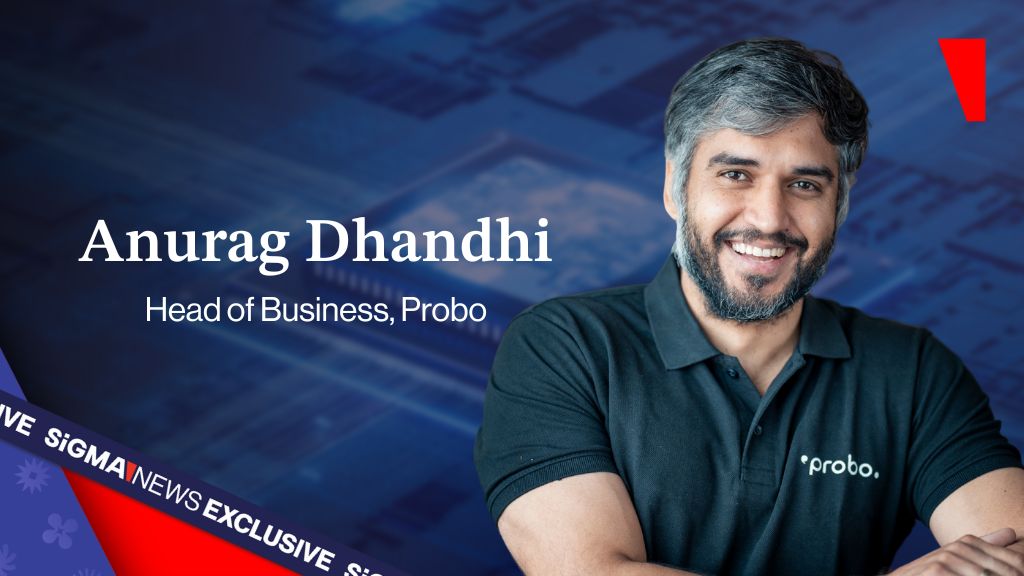
In an exclusive conversation with SiGMA News, Anurag Dhandhi, Head of Business, Probo, shares insights into how demographic shifts and evolving regulations are shaping the sector’s future. Dhandhi explores strategies to ensure sustainability while addressing regulatory concerns, highlighting the balance needed between fostering innovation and maintaining responsible practices.
Innovation vs oversight in opinion trading
SiGMA News: What are your views on India’s current regulatory landscape for opinion trading platforms? What kind of framework or regulatory model would help opinion trading grow responsibly?
Anurag Dhandhi, Head of Business, Probo: India’s regulatory landscape for opinion trading is still evolving and we believe thoughtful regulation can help this innovative sector grow while protecting users. Drawing from global best practices, we would welcome clear guidelines that recognise skill-based platforms differently from gambling, with sensible safeguards like Know Your Customer (KYC), identity checks and spending limits built in. Just as markets like the US have found balanced oversight approaches, India too can create a framework that encourages innovation while prioritising consumer protection, giving legitimate platforms room to operate and users’ confidence to participate responsibly.
SiGMA News: Do you see opinion trading eventually becoming a credible alternative or supplement to polling or traditional sentiment measurement in India and why?
Dhandhi: Absolutely. Real-time contract prices during events like elections reflect informed sentiment shifts, offering enterprises and policymakers dynamic, invested insights. This utility position opinion trading as a credible complement to traditional methods.
SiGMA News: How do you balance innovation with accountability, especially in an ecosystem that’s still maturing?
Dhandhi: Every user undergoes mandatory KYC verification process, ensuring only verified individuals participate while preventing underage access. We empower users with robust financial controls, including customisable deposit limits and investment caps, putting them firmly in charge of their spending. Features like the Secure Vault provide an additional layer of protection, while trading time reminders promote healthy engagement habits.
Clear event guidelines and verifiable outcomes ensure fairness, while comprehensive trade histories allow users to learn from every decision. For those needing a break, self-exclusion options provide flexibility without losing progress.
SiGMA News: Given the increasing scale and impact, do you believe a dedicated regulatory framework for opinion trading is imminent, and what role is Probo playing in shaping that conversation with policymakers?
Dhandhi: The development of a regulatory framework for opinion trading platforms remains an ongoing process, with timing dependent on broader policy considerations. As part of this dialogue, Probo contributes industry perspectives by sharing research findings on the skill-based nature of these platforms, comparative analyses of international regulatory approaches, and operational insights from implementing user protection measures—all aimed at informing balanced policy development that considers both market innovation and consumer safeguards.
Shaping India’s digital discourse
SiGMA News: Looking ahead, how do you envision opinion trading shaping the broader digital economy in India, particularly as a tool for civic engagement, public discourse, and data-driven insights?
Dhandhi: Opinion trading will fuel data-literate civic engagement. By turning public sentiment into tradable insights, platforms empower citizens to financially participate in discourse. This creates a virtuous cycle where informed users influence narratives, while aggregated data offers policymakers unprecedented visibility into crowd wisdom.
SiGMA News: Opinion trading in India has scaled to over 50 million users and $6 billion in annual transactions, what key factors have driven this explosive growth, and how sustainable is it?
Dhandhi: Opinion trading in India has witnessed a massive surge in popularity. This reflects a fundamental shift in how Indians engage with information via digital platforms. We have observed this surge is being driven by three interconnected factors: First, a growing appetite for platforms that reward knowledge and analytical skill rather than chance, particularly among India’s young, digitally-native population. Second, the model’s inherent versatility—from sports, current affairs, to economics, and entertainment as users seek to apply their expertise across domains. Third, the sector’s legitimacy has been mathematically validated by an IIT Delhi and Evam Law & Policy’s intensive studies, proving the skill-dominant nature of these platforms and how Indian companies have the potential to lead the information markets globally.
This growth trajectory is primed to stay northwards with several structural advantages. Unlike speculative markets, opinion trading’s value proposition improves as more skilled participants join—creating a virtuous cycle where better-informed crowds produce more accurate forecasts. This aligns with India’s digital upskilling movement, while global examples like regulated US prediction markets prove the model’s viability.

SiGMA News: With 100,000-200,000 daily active users and growing traction in categories like news and economics, what does current user behaviour tell us about the evolving nature of digital participation in India?
Dhandhi: User behaviour signals a shift toward knowledge-driven engagement. Beyond cricket, there is a growing engagement in other categories like news, economics, and other sports. In fact, every user trades in two categories on an average. High-skilled users spend 3x time researching before trading, reflecting deliberate analysis. Activity notably surges during major events like tariff wars or elections, revealing demand for platforms where expertise shapes outcomes—a move beyond passive consumption.
Further, there is also a growing percentage of top users using exit strategy to maximise their profits, implying they monitor the prices, and adjust their positions. More than 100,000 orders daily end up in profit by exiting their position despite incorrect outcome.
SiGMA News: Your data shows over 90 percent of top users start with less than ₹100 ($1.14). How do you design interface to support this ‘test-and-learn’ model for new users? What does this ₹100 trade tell us about user behaviour?
Dhandhi: New users start with trades amounting less than ₹100, enabling them to test strategies and understand the platform without exposure to risk. Our real-time order books, historical trade data, and news updates further support them with informed decision making. During this time, many watch our online tutorials as well to further deepen their understanding about all the tools and features at their disposal.
This ₹100 threshold reveals user caution and how they take their own time to understand our platform. They invest minimal amounts to master skills before scaling investment, prioritising learning over immediate profit.
SiGMA News: Tell us about safety features, adaptive recharge limits, time-outs, and cool-off periods. How effective have they been in protecting users?
Dhandhi: Safety features like adaptive recharge limits, cool-off periods, and time-outs, are designed to protect users while keeping the experience engaging. For instance, when we introduced mandatory breaks after 90 minutes of continuous trading, we saw a 40 percent drop in impulsive late-night trades. Over 100,000 daily trades now end early as users proactively secure profits, a clear shift toward thoughtful, strategic play. Even small features like deposit caps that adjust to individual behaviour, help create a safer space for learning and growth.
SiGMA News: Can you explain how your platform uses data and behavioural patterns to open new markets?
Dhandhi: We carefully watch what our users are naturally drawn to like the topics they research, the events they trade most, and the emerging trends they are passionate about. For example, when we noticed growing interest in economics and global sports beyond our usual cricket markets, with users actively trading policy changes and geopolitical events, we responded by creating more structured contracts in these areas. It is like having a pulse on collective curiosity—when enough users consistently engage with specific real-world topics, that’s our signal to develop those into proper markets. This organic approach ensures we’re always offering opportunities that genuinely reflect what our community wants to analyse and predict.
We have seen this play out seamlessly with policy-related contracts, where engaged users trading nuanced political developments showed us there was demand for more sophisticated markets in this space. It is a continuous conversation between our platform and our users’ evolving interests.
SiGMA News: In the US, opinion trading, have seen increasing institutional recognition, with platforms like Kalshi engaging with regulators like the Commodity Futures Trading Commission (CFTC) under clear oversight frameworks. How does India’s regulatory approach to opinion trading compare, and what lessons can be drawn from the US in balancing innovation, consumer protection, and market legitimacy?
Dhandhi: The US market demonstrates how regulated prediction platforms can drive economic value while maintaining oversight. Platforms like Kalshi, operating under CFTC regulation as forecasting tools, have achieved a $2 billion valuation with support from prominent investors. Their strategic partnerships including with Robinhood, highlight the sector’s growing legitimacy. Similarly, Polymarket, backed by PayPal and Peter Thiel, has partnered with X (formerly Twitter) to integrate prediction markets with social media. The industry’s momentum is further underscored by Susquehanna International Group (SIG), a major Wall Street quantitative trading firm, now entering sports trading—a testament to the sector’s dynamic evolution.
I’m excited to announce our $185M Series C valuing Kalshi at $2B.
— Tarek Mansour (@mansourtarek_) June 25, 2025
The round was led by Paradigm with participation from Sequoia, Multicoin, Peng Zhao, Neo, and Bond Capital.
People choose to work at Kalshi not because of the money we've raised, but because of our ambition:… pic.twitter.com/OGgZSwOPvj
India has an opportunity to replicate this success by establishing clear regulatory frameworks. Defining jurisdictional authority would not only expand the economy but also increase tax revenues and create employment.


