


Robots take centre stage at CES 2026: the age of AI croupiers draws closer

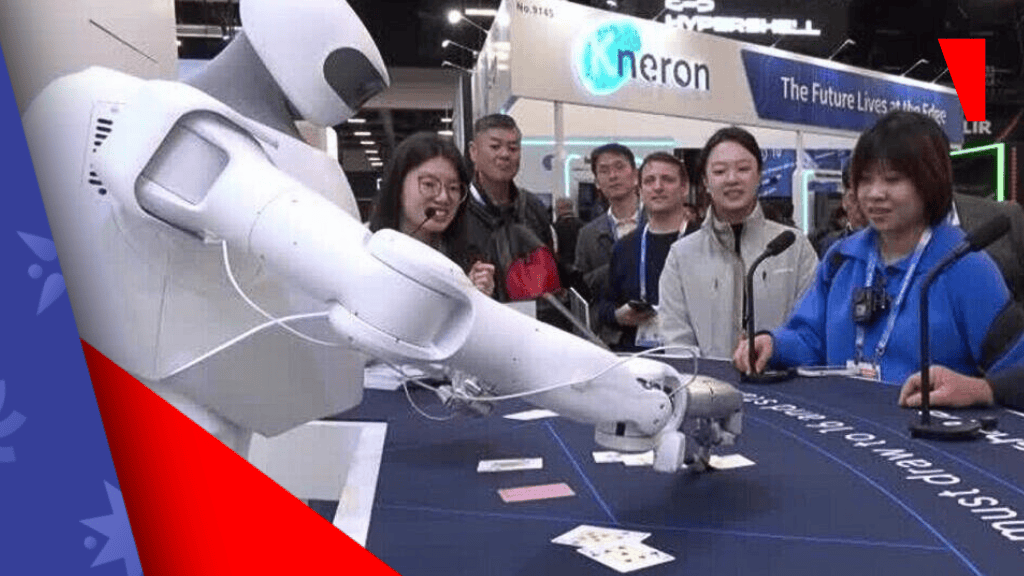
At the Consumer Electronics Show in Las Vegas, robotics reveals its most advanced side. Between automation, artificial intelligence and human interaction, the casino industry is watching closely: could robots really become the dealers of the future?
CES 2026 places Las Vegas at the heart of global innovation
CES 2026, currently underway in Las Vegas and running until 9 January, once again confirms its status as the world’s leading showcase for technological innovation. Amid crowded halls and live demonstrations, one theme clearly stands out: the level of maturity reached by robotics and artificial intelligence. This is no longer about experimental prototypes or futuristic concepts, but about solutions that are already ready to enter everyday life and operational environments.
Visitors to the exhibition find themselves immersed in an ecosystem where humanoid robots walk with increasingly fluid, human-like movements, recognise their surroundings and interact with people in remarkably natural ways. Alongside them, a new generation of domestic robots is capable of carrying out complex tasks such as loading washing machines, folding laundry and assisting elderly or vulnerable individuals. It is a clear sign of a profound transformation: automation is no longer confined to factories, but is moving into social and commercial spaces.
Robotics and AI: from support tools to leading actors
Companies at CES are focusing on machines designed not only to perform specialised tasks, but also to collaborate directly with humans. Today’s robots are built to assist, support, and, in some cases, replace people in repetitive, physically demanding, or potentially dangerous roles. This evolution offers significant opportunities in terms of productivity and efficiency, while also raising important questions about the future of work.
These dynamics are particularly relevant for sectors such as entertainment and gaming, where technology has always played a central role in competitiveness. It is here that one of the most widely discussed applications of advanced robotics is capturing the attention of industry operators.
The future of casinos: robot croupiers at the tables
Among the most intriguing scenarios to emerge at CES 2026 is the potential introduction of robot croupiers within casinos. The idea of a machine capable of managing a blackjack table or dealing cards in a poker game is no longer pure science fiction. Advances in artificial intelligence, combined with vision systems, voice recognition and sophisticated motion control, are making this prospect increasingly realistic.
A robot croupier could manage game dynamics with absolute precision, handling card counting, bet collection and card distribution without any margin for error. Thanks to advanced voice interfaces, it could also interact smoothly with players, explain the rules and ensure full compliance with procedures. The ability to supervise multiple tables simultaneously would guarantee operational continuity and more efficient floor management.
Efficiency, cost reduction and transparency: the benefits of automation
From an operational perspective, deploying robots in casinos could lead to lower costs and higher efficiency. Automation promises greater transparency and impartiality, significantly reducing inaccuracies linked to the human factor and strengthening player trust in gaming systems. This is a particularly relevant aspect in an industry that is increasingly focused on compliance, regulation and operational integrity.
At the same time, this technological shift inevitably fuels debate around the role of human staff. Dealers, cashiers and floor personnel have long represented the human face of casinos, and the prospect of their replacement raises concerns about employment and the erosion of established professional skills.
Threat or opportunity for live gaming?
Approaching robotisation requires balance. Automation can relieve people of repetitive tasks, allowing them to focus on higher-value activities such as customer relations and experience-driven services. In live gaming, where social interaction is an essential part of the appeal, the future is likely to lie in hybrid models.
Robots could be deployed in dedicated areas or fully automated games, while human dealers would remain at the core of more immersive, socially rich experiences. Such an approach could strike a balance between technological innovation and the preservation of human expertise.
This article was first published in Italian on 7 January 2026.
Be part of the action! Join the world’s biggest iGaming community with SiGMA’s Top 10 News countdown. Subscribe HERE for weekly updates, insider insights, and exclusive subscriber-only offers.


