

Affiliates in 2026: from CPA to KPIs, new algorithms and a maturing industry

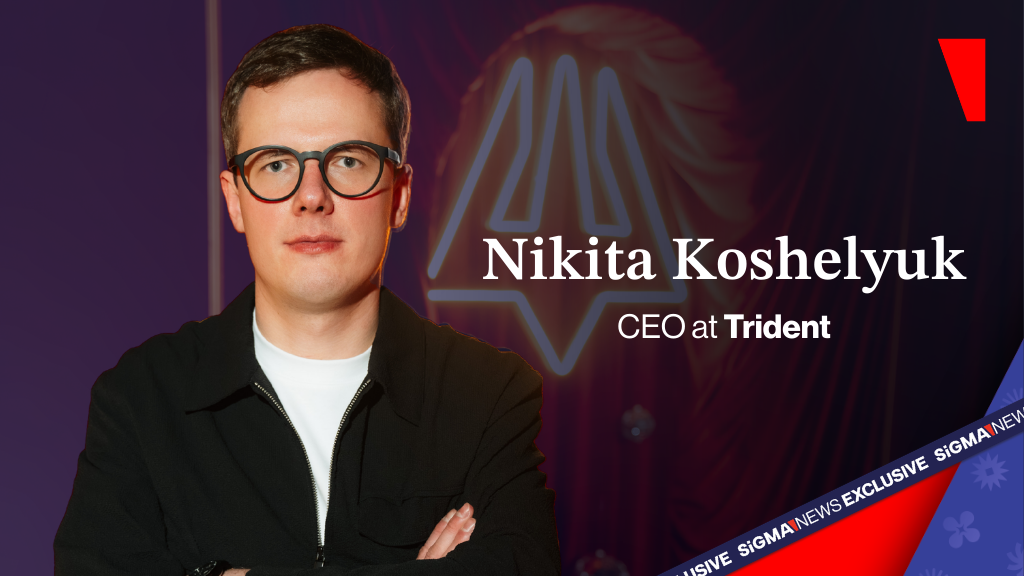
Affiliate marketing in iGaming is undergoing a transformation. In 2026, the market is being shaped by new advertising algorithms, changes in the economics of affiliate models and the widespread adoption of AI across workflows. In an exclusive interview with SiGMA News, Trident CEO Nikita Koshelyuk explains why media buying teams are becoming more mature, why the classic CPA model is on the way out, which markets will be prioritised, and how the practical application of AI is accelerating creative generation and analytics.
Trident is a performance-driven affiliate company operating in the global iGaming market. Over the past six years, it has grown from a small team of four people into an ecosystem of performance and tech businesses with over two hundred specialists. The company’s development demonstrates in practice how teams are adapting to the new reality.
How AI is changing media buying and traffic acquisition
When it comes to the work of media buying teams, Trident began using many AI tools well before 2026. The first were tools that simplified and accelerated design work, including the generation of assets, elements and other visual materials for advertising.
Last year, the team began actively integrating AI into the development of internal services, including writing code for internal tools and solutions. These are mainly widely used tools such as Leonardo, Krea and Cursor. In the coming months, the team plans to implement its own hybrid LLM model, integrated with one of the market solutions, into its enterprise resource planning (ERP) system and internal applications.
‘The idea is to analyse the user against the patterns of previous players as soon as traffic is launched, cross-reference this data with our BI tools, and direct the user to the offer that best matches their behavioural profile,’ explains Nikita.
At the ERP level, the AI-based system will be able to decide which offer to direct the user to, depending on the specific buyer, funnel and traffic source. This will simultaneously maximise profit for the company and ensure the highest quality and performance for the operator.
Andromeda: when creativity became targeting
Expanding on the topic of AI applications, Nikita mentions Meta’s innovation called Andromeda. Previously, Meta’s ad delivery system relied on three main stages: Retrieval, Ranking and Delivery. However, Retrieval – the stage at which the system selects all potentially suitable ads – remained the weakest link for a long time. With the arrival of Andromeda, Meta has effectively shifted from a model where the advertiser, i.e. the media buyer, determines the targeting, to a model where targeting is determined by the system based on the creative itself. Nikita considers this change in ad buying to be the most significant since iOS 14.
‘Today, creative is becoming the primary targeting mechanism,’ notes Nikita. Instead of relying on interests, demographics or manual audience segmentation, the system analyses the creative itself: visual cues, text, tone of communication, movement and the dynamics of the video. Based on this, the algorithm predicts user intent. This means that it is the creative itself, rather than targeting settings, that determines who will see the advert.
As a result, detailed targeting becomes less effective, and sometimes even counterproductive. In many cases, according to Nikita, the most effective strategy is to run campaigns ‘broadly’, allowing the algorithm to find the relevant audience on its own.
Another important change relates to creative variety. Previously, a media buyer could find one or two successful creatives and scale them up by making minor changes: changing the background, adding a blur effect, or editing the text. Today, the system recognises such changes as duplicates. To avoid a drop in conversion rates and a decline in campaign performance, Nikita recommends creating fundamentally different concepts: UGC formats, gameplay simulations, reviews, and narrative videos.
However, this requires a major overhaul of processes within teams: ‘Media buyers are now paying more attention to analysing why a particular creative was successful. Production teams must generate significantly more hypotheses and concepts. Many large teams are already setting up separate departments dedicated to UGC content and working with AI models; we are no exception. The structure of campaigns is also changing: more and more attention is being paid to testing and retargeting.’
Why the market is gradually moving away from CPA
Nikita describes the market’s transition from the classic CPA model to KPI and value-based approaches as an economic necessity. CPA no longer reflects the real value of a user, as it measures an action rather than long-term value. ‘But the operator’s business is built on customer value,’ he emphasises.
The main problem with the classic CPA model is that it does not take LTV into account, Nikita continues. Affiliates receive the same payment for players who quickly leave the product as they do for those who remain active for a long time and generate stable revenue. As a result, the affiliate’s focus shifts to the cost of conversion rather than the quality of the audience.
Under the CPA model, the main risks lie with the advertiser, who pays for each player regardless of their subsequent behaviour. Affiliates, in turn, are motivated to increase volume rather than the quality of traffic. Regulation adds further pressure: AML and KYC requirements, transparency of traffic sources, and legal compliance checks.
Operators can no longer afford traffic with low retention rates. KPI- and value-based models help solve this problem. They incentivise affiliates to work with a high-quality audience and reduce the risks of fraud and chargebacks. The CPA model is simple, but it is precisely this simplicity that makes it vulnerable to fraud.
Market maturity also plays a role. In verticals such as iGaming, finance or SaaS, the cost of customer acquisition is constantly rising. It is important for brands not only to acquire a player but also to retain them, maximising LTV. The CPA model is less suited to managing this process, but it will not disappear entirely, according to Nikita:
The CPA model remains, but ceases to be a growth tool. By 2026, it will become an entry-level tool.
How affiliates and operators are adapting to this
The affiliates’ workflow is undergoing changes. Teams are beginning to analyse LTV by source in much greater depth and are paying more attention to audience selection. The focus is gradually shifting from traffic volume to its quality.
Integration with operators is also increasing. Trident is adding custom postbacks and additional parameters that allow them to account for player value and deposit amounts on their side: ‘This makes it possible to analyse the revenue the operator generates from our traffic and move towards individual KPI models with partners.’
Furthermore, more and more resources are being invested in analytics and proprietary data. Working with KPIs is impossible without high-quality analytics. Many affiliates are rolling out their own BI systems and building predictive models to minimise the likelihood of cuts or holds. Data and the ability to analyse it are becoming a key competitive advantage.
Operators are also adapting and are increasingly using dynamic payouts. These systems allow the payout amount to be adjusted depending on the quality of the traffic, which makes the distribution of risks between the parties fairer.
Finally, data sharing is increasing, Nikita continues. Operators are sharing more in-depth analytics on user behaviour within the product, which helps affiliates better understand the quality of their traffic. Key KPIs are gradually shifting towards longer-term metrics:
- OAS over 14 and 30 days;
- average spend;
- LTV.
Nikita believes this is a positive change for the market: ‘Weak players who focus solely on traffic volume are gradually disappearing, and arbitrage is becoming closer to classic performance marketing.’
In 2026, those who understand how to create value for their partners will come out on top.
AI in creative production
AI has radically shortened the path from hypothesis to test, says Nikita. In iGaming, where thousands of creatives are generated every month and effectiveness can drop within days, speed is becoming a strategic factor. AI quickly generates backgrounds, characters, format variations and even videos, turning what used to take days into a task that takes hours and freeing designers from routine work.
In static creatives, this speeds up asset preparation and scaling: adapting formats, generating variations and expanding compositions require less manual work.
In video production, the effect is even more noticeable: scenes, animation and UGC-style content can be assembled quickly without a full shoot, allowing more ideas to be tested with less time and budget.
At the same time, certain limitations remain. AI tools do not always accurately reproduce real gameplay or interface logic and may make errors in the details, ranging from incorrect text to visual distortions. Therefore, the human role remains key: they formulate the task, understand the product, the offer, the audience and the market context. ‘AI speeds up the implementation of ideas, but does not replace specialists,’ concludes Nikita.
The impact of regulation
In practice, the impact of regulation on affiliates’ work is fairly limited. The main factor is restrictions on creative content. There are certain elements and phrasings that cannot be used in advertising materials, and teams simply adhere to these rules. Essentially, the marketer’s task remains the same: to create content that sparks interest and resonates with the audience, whilst not breaching platform rules or damaging the operator’s brand. ‘Therefore, regulation tends to set the framework within which the industry operates, but does not directly determine the scaling strategy or the choice of traffic sources,’ comments Nikita.
Are Tier-1 markets overvalued?
Nikita partly agrees that Tier-1 markets are overvalued in iGaming. A huge number of operators and affiliates are active in these regions, leading to fierce competition for players. As the cost of acquisition is constantly rising, entering such markets can be very expensive and risky for newer or smaller teams. ‘CPC and CPM are significantly higher here than in Tier-2 or Tier-3 markets,’ he notes.
Nevertheless, Tier-1 markets will remain relevant for a long time to come. High standards of living and developed economies create a premium segment of players. ‘But when it comes to margins, today they are closer to a sustainable norm than to the super-profits seen a few years ago,’ Nikita continues.
In terms of new opportunities in 2026, he is interested in the markets of Southeast Asia, such as Thailand, Vietnam and the Philippines. These countries have a high share of mobile traffic, relatively low competition and a more accessible advertising auction. Indonesia and Bangladesh also look promising, adds Nikita.
LATAM has become more complex following the introduction of regulation, but at the same time, more predictable. Brazil and Mexico are gradually forming a more stable ecosystem. Nikita also highlights Africa as an interesting region, where the number of mobile users is growing, and the number of operators is increasing.
Scaling Trident: from 4 people to 200+
Over the past five years, Trident has evolved from a small team into a large ecosystem of performance-tech businesses in the iGaming sector. Speaking about the choice of operational model and culture, Nikita notes that ‘there is no single universal management format that works at all stages of growth.’ At each stage, the team had to rebuild the management model and adapt processes.
‘At the start, it was a typical founder’s story: hands-on management, quick decisions and high involvement in every process. But scale does not tolerate chaos,’ Nikita continues. As the company grew, a structure was established with clear areas of responsibility: media buying, account farming, development, creative, finance and other operational departments.
Now, the company’s strategy, risk management and finance are centralised, whilst the teams operate as independent units with their own P&L metrics and accountability for results. ‘Today, our model is a balance of control and freedom,’ notes Nikita.
The operational departments work according to the OKR methodology. Decisions are made as close as possible to the people carrying them out, so everyone understands their area of responsibility and their impact on the overall result. Nikita believes that this is precisely what has allowed the company to grow without losing momentum.
‘We really don’t want to become a cumbersome organisation with a lot of unnecessary approvals, so we constantly review our processes for efficiency. The incentive system is directly linked to profit. This encourages media buyers to take the initiative and seek out new areas for growth,’ he explains.
At the same time, particular attention is paid to the company’s internal culture. The company strives to create an environment where every employee’s performance is visible and where people motivate one another through their results. As open communication and feedback are priorities, employees have the opportunity to voice their ideas and criticism at any level. The company also holds regular All-Hands meetings. Once a month, the whole team gathers to discuss financial results, strategic plans, successes and mistakes. This builds trust and helps every employee understand how their work impacts the overall result.
One of Trident’s key values is continuous development: ‘In the affiliate industry, knowledge becomes outdated very quickly, so the speed of testing and the constant exchange of experience between teams play a key role. We still call each other family, but we understand that our task now is to build a systematic company.’
Ukraine: a hub or a centre of expertise?
Many well-known media buyers in the iGaming industry, including Trident, have Ukrainian roots. When asked whether Ukraine can still be called a media hub in iGaming, Nikita draws attention to the military conflict, which has brought about significant changes. Many specialists and teams were forced to relocate, and companies have opened offices in Europe. Therefore, it is more accurate today to speak of a centre of expertise.
At the same time, the Ukrainian community remains very active. Many local events and meetings are held where specialists exchange experiences. The company regularly organises Trafficroom by Trident events, bringing together team leaders and top industry specialists.
Diversification as a natural progression in iGaming
Many teams from the media buying and affiliate marketing sectors are currently transforming by setting up their own operators. There are now plenty of solutions on the market that make this possible relatively quickly. In iGaming, this is one of the main trends.
However, the Trident team currently prefers to create products and services within the existing ecosystem: ‘We aren’t actively moving in that direction yet, but we don’t rule out that we may eventually get there.’
The company already has a service for renting and developing mobile apps, and future solutions will likely be aimed at meeting the needs of teams and users within the industry. It is also considering the creation of SaaS solutions: ‘We clearly see the problems that exist in current trackers on the market, and we want to try to solve some of these issues.’
‘Today, it’s not enough just to know how to buy traffic’
Looking at the affiliate market today, it is clear that the industry is gradually moving beyond the stage of quick fixes and entering a more mature phase. AI has already become part of teams’ daily work, new algorithms are changing the mechanics of purchasing, and affiliate models are gradually moving away from simple CPA towards approaches where the actual value of the user to the business is key.
Nikita Koshelyuk is convinced that the main shift is taking place not in technology, but in the very approach to work. Arbitrage is looking less and less like a story of lucky combinations and rapid scaling. It is increasingly becoming a fully fledged performance business, where analytics, the operational system within the team, the speed of testing, the decision-making culture and an understanding of the product are crucial:
The market is becoming more complex, and that’s normal. It’s always like that in mature industries.
In these conditions, the teams that succeed are those that can adapt quickly, build robust analytics, experiment with creative approaches, and think not only about conversion but also about the long-term value of the user, and this is the key change of recent years. ‘Nowadays, it’s not enough just to know how to buy traffic. You need to know how to build a system around it,’ concludes Nikita.
This article was first published in Russian on 16 March 2026.
Brazil’s not waiting, and neither should you. BiS SiGMA South America, 06–09 April 2026, brings 18,500 delegates, 250+ sponsors to LatAm’s gaming capital. São Paulo’s bringing more sizzle than a beachside samba. Get in early or get left behind.


