


How evolving B2C–B2B dynamics are reshaping iGaming partnerships

After several years of structural change, the iGaming industry is entering a phase of sustained expansion shaped by regulation, technology and shifting consumer behaviour. Industry estimates show the global online gambling market was worth about US$78.66 billion in 2024 and is expected to grow to roughly $153.57 billion by 2030, driven by continued expansion across online casino and betting platforms.
The expansion has been supported by mobile-led platforms, increased use of analytics and gradual upgrades to platform infrastructure. At the same time, operators are putting more resources into cloud technology and performance tracking as market competition intensifies.
As the market scales, cooperation between operators, suppliers and platform providers has become more central to commercial performance. Analysts have consistently pointed to closer alignment between B2C and B2B functions as a factor influencing product relevance, operational efficiency and long-term competitiveness.
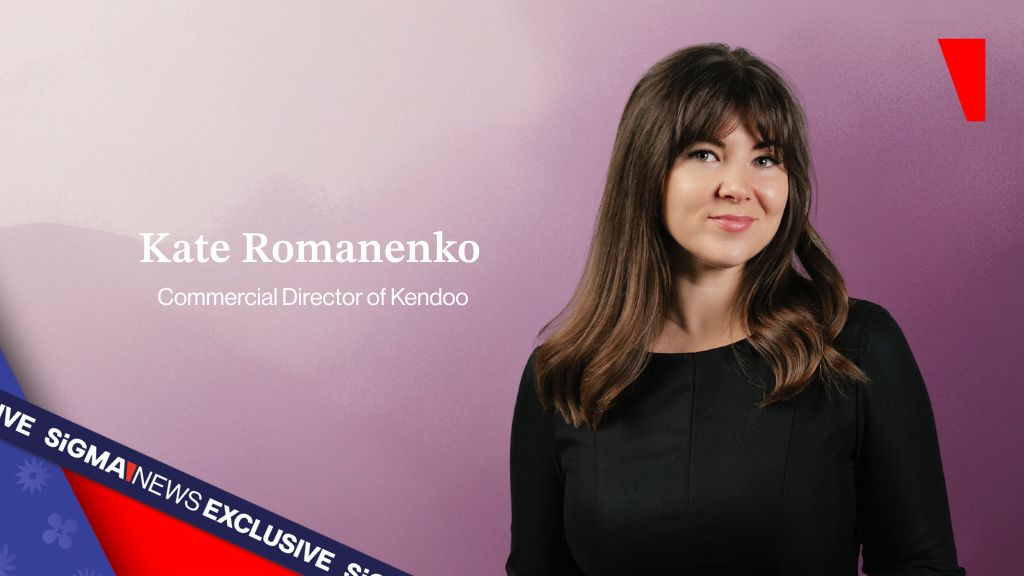
Regulatory developments are also affecting market focus. Brazil’s move to licence online betting in 2025 has increased interest from operators and suppliers but has also brought additional compliance and certification obligations. Against this backdrop and on the sidelines of ICE Barcelona, SiGMA News spoke to Kate Romanenko, Commercial Director at Kendoo, about how these structural shifts are reshaping industry relationships and strategy.
Understanding both sides of the market
As the iGaming industry becomes more competitive and operationally complex, the relationship between operators and suppliers is under increasing scrutiny. Experience across both sides of the market, according to Kate, has become a practical advantage rather than a bonus.
Kate has worked across both B2C and B2B roles, and she believes that understanding how both sides function is essential to long-term success. “It’s very important to understand the whole picture, what we often call the internal kitchen of both sides,” she says.
For suppliers, this means recognising the pressures and challenges faced by B2C businesses. Kate notes that having “a very good understanding, a very good feeling of what can be the problem for the B2C businesses” helps suppliers deliver more relevant products and services. Even while working in B2B, she remains closely interested in how operators function. “Our job is to make sure that the life of our customers becomes easier by working with us,” she says.
How supplier and operator relationships have changed
Kate joined the iGaming industry around 10 years ago, at a time when the number of game studios was far smaller than it is today. She recalls that success was defined differently, with content playing a less central role.
“It wasn’t about the content so much,” she says, noting that performance was often driven by nostalgia and players’ offline habits. While those habits still exist, they no longer dominate decision-making in the same way.
Today’s market looks very different. The number of studios has increased significantly, and technology has advanced alongside it. Analytics now underpin how games are developed, promoted and evaluated.
Kate points out that data systems in the past were basic compared with what is available now. “Today we have so many tools that help us make our content better, make our approach towards promotions better, and make better decisions,” she says.
Data, she adds, has become a critical factor in improving performance. “Data is really big today. I’m very grateful for that, because that helps us do our job better.”

What makes partnerships work
As competition intensifies, partnerships between B2C and B2B companies have become both more important and more complex. Kate describes genuine partnerships as something that can seem complicated but is, at its core, straightforward.
“What you need is two sides to want to work together, to want to do great results together, to make money, to perform,” she says.
While expertise on both sides remains important, Kate does not see deep industry experience as a barrier to partnership. She says both B2C and B2B businesses need to understand what they are doing when they come together, and it is beneficial if they also understand each other’s business models. However, she does not view this as a strict requirement. Partnerships, she argues, can still move forward even when one party has limited experience or is new to the industry.
“The most important thing is the goal,” she says. “The goal is to make a business. It’s a mutual partnership.”
Beyond technical knowledge, she highlights the importance of communication. Hard skills alone are not enough. “Without soft skills, the communication will be harder, more difficult, and more misunderstood,” she explains. Strong communication and interpersonal skills on both sides, she adds, significantly increase the likelihood of success.
Why human connection still matters
Despite the industry’s growing dependence on technology and data, Kate says human interaction continues to play an important role. “Connections and communication skills and your genuine approach towards business” remain central, she says.
She adds that motivation matters just as much. Being genuinely interested in the work helps drive progress, while a lack of engagement can slow momentum not only for individuals but for the wider business.
Portfolio strategy in an oversupplied market
With new games launching at a rapid pace, portfolio strategy has become a key issue for both operators and suppliers. Kate observes that diversification is often discussed in terms of quantity.
“The quantity is always important, but the quality is still the king,” she says.
She stresses that this does not mean limiting the number of suppliers or games. There is space in the market, she argues, for all studios that aim to build sustainable businesses. However, quality requires time, talent, budget and expertise.
Kate says diversification needs to balance quantity and quality, but she cautions against expecting uniform success across a portfolio. She does not believe any supplier sets out to release only a small number of games with the expectation that all will perform strongly. “We all have some top performers, and then there is also some content which will not perform the best,” she says. Operators, she adds, see the same pattern across their own portfolios. This, she added, is a normal part of the market, and continued effort and experimentation remain necessary.
Balancing innovation and familiarity
Product strategy also involves balancing innovation with familiarity. Kate describes the product as the centre of commercial decision-making. “The product we bring into the market to our clients is the key,” she says.
Familiarity continues to influence player behaviour. “Players trust more what they recognise,” she notes, whether that applies to a game, a brand or a platform.
At the same time, she does not view familiarity as a reason to avoid innovation. Innovation, in her view, is about steady progress rather than dramatic change. “Make your technology or make your feature or make your UI better than yesterday,” she says.
Kate says innovation needs to be handled carefully and supported by testing, as it always involves risk. Changes can affect the player experience if they do not work as intended, but they can also lead to new opportunities. “Something may not work, or it can actually bring you the next big thing,” she says. For her, innovation means trying new ideas while also reusing elements from the past, and keeping space open for both opportunity and risk.
Launching a studio in a crowded market
While speaking about Kendoo’s first year as an independent studio, Kate says entering the market has brought both advantages and challenges. Although the brand is new, she notes that the team already had experience developing games before launching under its own identity.
“Our main advantage is that we already knew how to make games,” she says, pointing to the studio’s background in slot development prior to operating as an independent brand. Moving to market under its own name, however, required time and adjustment.
Being new, she says, comes with both benefits and disadvantages. Building brand identity and trust does not happen immediately, particularly with players, whom Kate describes as the industry’s main customers. That trust, she explains, is developed gradually through partnerships and product performance.
Testing and measured change have therefore been central to the studio’s approach. The team has continued to use mechanics and structures that are already proven in the market, while carefully introducing new elements. One recent example is the release of 4 Egypt Scarabs, the first four-pot game in Kendoo’s portfolio, following earlier success with three-pot formats.
“This is something definitely new that we add to our games creation process,” Kate says. Not every change will work, she acknowledges, but that does not make experimentation unnecessary. “If you believe in the idea, if you believe this should really work, it’s definitely worth giving it a try,” she says, while also stressing the need to remain aware of risk.
Regulation and market focus
Regulatory considerations continue to shape how studios and suppliers approach market expansion. Kate describes the regulatory environment as one of constant movement, with rules evolving, new markets opening and others becoming more restrictive over time.
Decisions around where to operate, she notes, are ultimately commercial choices made by individual businesses. Companies assess risk and decide accordingly, and there is no single right or wrong approach.
Entering regulated markets, however, requires significant preparation.
Kate points to Brazil as an example, where the introduction of a licensing framework has increased interest from suppliers but also raised the bar for entry. Certification, legal requirements and compliance work must be completed before operations can begin. “It’s a lot of work, a lot of preparation, and you haven’t even started yet,” she says.
For Kate, expansion is only justified when it is backed by a clear strategy and a clear understanding of why a market matters. At the same time, she notes that non-regulated markets continue to play an important role globally and remain part of the wider iGaming ecosystem.
Stay in the loop and join the biggest iGaming Community in the world with SiGMA’s Top 10 news countdown. Subscribe HERE for weekly updates from the world’s iGaming authority and exclusive subscriber-only offers.


