


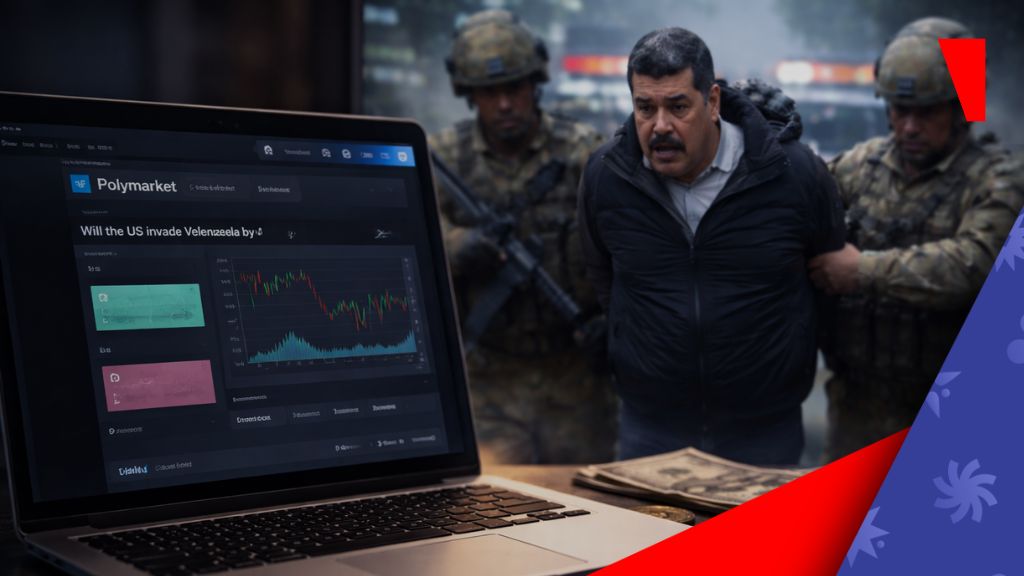
Blockchain-based prediction platform Polymarket is facing backlash from traders after refusing to settle millions of dollars in wagers tied to a US invasion of Venezuela, arguing that the capture of President Nicolás Maduro does not meet the platform’s definition of an invasion.
As reported by The Guardian, the dispute centres on a series of high-volume prediction markets that asked whether the United States would invade Venezuela or whether Maduro would be removed from power by specific deadlines in early 2026. Despite US forces seizing Maduro during a surprise military operation, Polymarket ruled that the event did not qualify as an invasion under its contract terms.
The decision has left traders frustrated, particularly those who placed bets totalling more than $10.5 million on invasion-related outcomes due to settle by 31 January 2026.
Bets surge ahead of Maduro’s capture
In the days leading up to the operation, activity on Polymarket spiked as traders speculated on escalating US-Venezuela tensions. On 3 January 2026, US forces launched Operation Absolute Resolve, capturing Maduro and his wife, Cilia Flores, during a coordinated air and ground mission. The pair were later transferred to New York to face US drug trafficking and narco-terrorism charges, which Maduro has denied.

Ahead of the operation, an anonymous Polymarket user placed more than $30,000 on markets predicting that Maduro would be out of office by 31 January. Following the news of his capture, the position briefly showed profits exceeding $436,000, representing a return of more than 1,200 percent.
However, Polymarket later clarified that the event did not trigger a winning outcome. Following the announcement, the implied probability of a US invasion before the end of January collapsed to below five percent.
Platform cites strict contract wording
In a statement published on its website, Polymarket said the contract referred specifically to “US military operations intended to establish control” over Venezuelan territory.

“President Trump’s statement that the US would ‘run’ Venezuela, while referencing ongoing talks with the Venezuelan government, does not alone qualify the snatch-and-extract mission to capture Maduro as an invasion,” the platform said.
The ruling has drawn sharp criticism from users, some of whom accused the platform of redefining outcomes after the fact, as reported by The Guardian. One trader, posting under the name Skinner, said the decision showed “sheer arbitrariness”, arguing that the capture of a sitting head of state during a military incursion should meet any reasonable definition of an invasion.
Betting on war raises ethical questions
Polymarket, launched in 2020, allows users to stake on yes-or-no outcomes linked to real-world events using cryptocurrency. In recent months, the platform has pushed the boundaries of event-based trading by listing markets tied to military conflict, political collapse, and regime change.
Venezuela-related markets gained momentum as tensions escalated, with users actively trading contracts linked to US military engagement and Maduro’s removal from power. Implied probabilities on some contracts jumped from single-digit percentages to above 99 percent within hours of the operation becoming public.
Other escalation scenarios, such as a formal US invasion or declaration of war, continued to trade at lower probabilities, typically between two percent and nine percent. Markets tied to maritime seizures, drug interdiction operations, and Venezuelan shipping activity traded in the 50 to 66 percent range.
Trading volumes across these markets ranged from approximately $926,000 to nearly $3 million, highlighting the scale of capital involved.
Some researchers argue that such markets reflect speculative sentiment rather than meaningful forecasting. “When people start wagering on war, we lose sight of its human cost,” said Ananay Jain, policy and gaming-law expert at Grant Thornton Bharat LLP, previously speaking to SiGMA News. “These markets monetise fear. The legality issue is secondary to the moral one.”
Scrutiny over insider trading intensifies
The controversy has also reignited concerns over insider trading on prediction platforms. Analysts have pointed to unusual on-chain behaviour, including concentrated buying from newly created wallets focused exclusively on Venezuela-related markets.
Entrepreneur and investor Joe Pompliano added fuel to the debate, writing on social media that “insider trading is not only allowed on prediction markets; it’s encouraged”, a remark that has been widely shared.
A competing platform, Kalshi, had placed the odds of Maduro leaving office before February at around seven percent, compared with Polymarket’s 5.5 percent, raising further questions about how such low probabilities aligned with the trader’s precise timing.
US lawmakers move toward regulation
Amid this, US Representative Ritchie Torres, a Democrat from New York, has announced plans to introduce the Public Integrity in Financial Prediction Markets Act of 2026.
The proposed legislation would prohibit members of Congress, political appointees, and executive branch employees from trading prediction market contracts tied to political outcomes or government action if they have access to non-public information.
The bill would extend insider trading standards used in traditional financial markets to political and policy-based prediction contracts. Supporters say the move is necessary to protect public trust and prevent the misuse of sensitive intelligence.
Stay in the loop and join the biggest iGaming Community in the world with SiGMA’s Top 10 news countdown. Subscribe HERE for weekly updates from the world’s iGaming authority and exclusive subscriber-only offers.


