


Building trust in AI: Insights from MDIA at SiGMA AIBC Euro-Med

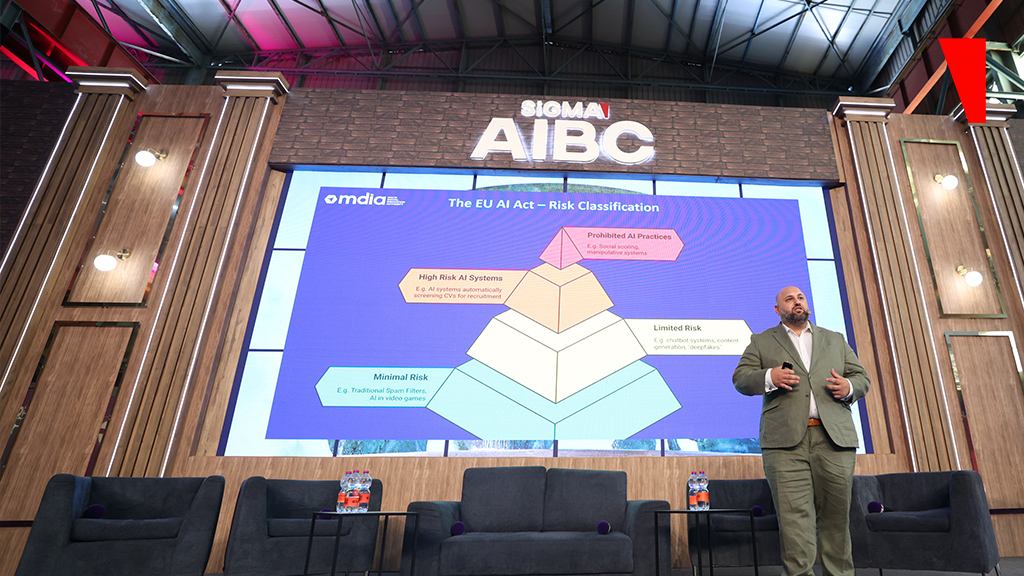
Speaking on the AIBC stage at the Euro-Med conference taking place today at the Mediterranean Maritime Hub (MMH), Mr Gavril Flores, Chief Strategy, Policy and Governance at the Malta Digital Innovation Authority delivered a keynote on the future of trustworthy AI and Malta’s governance approach.
When we think of safety in AI, he emphasised the need to ask: Why is it important and why should we have governance around it?
If we look at the pace of progress – from GPT-1 to GPT-3, and now to GPT-5 – the development cycles are accelerating dramatically, Flores claims. AI is being deployed across diverse scenarios: from drug discovery and cancer research, to smart farming and broader scientific innovation. These advances are making AI not only more powerful, but also cheaper and more accessible.
This brings both opportunities and, as he cautions: challenges.
On the plus side, AI is significantly advancing healthcare and scientific research, making once out of reach tech more approachable and scalable, and drastically lowering development costs.
This said, challenges, such as privacy concerns, job displacement, concerning bias, reliability and risk of errors underscore the need for transparency and accountability.
“Many mistakes in AI can be prevented if we test for bias prior to deploying solutions, ensure oversight, and implement proper safeguards before deployment.”
The global AI landscape
- Corporate investment in AI reached $252 billion in 2024.
- Over 69 countries have developed AI strategies.
- Around 50% of people in Malta say they know something about AI.
- 24% of the Maltese population report high trust in AI.
However, trust should not be given blindly, he warns. It must be earned. “Building trust requires a strong governance framework and an ecosystem where people feel confident that AI is being developed responsibly.”
The AI Act: Europe’s regulatory approach
Addressing what he calls the elephant in the room – the EU AI Act, something Flores describes as ‘one of the most significant pieces of legislation in recent years’. Its approach, he explains, is to categorize AI systems based on risk:
Prohibited AI systems (from 2024/2025)
Examples: social scoring, manipulative systems (e.g., in gaming, using data to create simulations that encourage addictive or anxious behavior).
Penalties: fines up to 7% of global turnover or €35 million.
High-risk systems
Examples: automated decision-making in critical sectors, biometric systems, healthcare, or recruitment.
Requirements: risk management systems, data governance, cybersecurity, conformity assessments (CE marking), transparency, documentation, logs, and human oversight.
Limited-risk systems
Example: chatbots.
Requirement: disclosure that users are interacting with an AI system.
Minimal-risk systems
Around 90% of AI use cases fall into this category.
He also brings up the controversial issue of deepfakes – which must also be addressed.They, he says, must be labeled as such, unless clearly satirical or obvious to an average consumer.
Malta’s role: MDIA as regulator and enabler
The Malta Digital Innovation Authority (MDIA) serves as both a regulator and an enabler of innovation. Flores outlines responsibilities to include, market surveillance & conformity assessment, providing ecosystems for innovation: such as bootcamps, summer camps, and scholarships for youth, supportive infrastructure (e.g., high-performance computing), and office space and resources for startups.
AI Sandbox (launched in 2021):
A safe space to test AI systems before large-scale deployment
Guidance, feedback, and compliance support
Model now being adopted across the EU (mandatory from next year)
Helpdesk support: answering queries on the AI Act and regulatory compliance
He wraps things up with the acknowledgement that Malta was one of the first countries in the EU – and even globally- to launch an AI Sandbox. The country’s approach, he divulges, combines regulation with support for innovation.
Trust in AI, he concludes, must be earned through transparency, accountability, and strong governance. With the right framework, AI can flourish while safeguarding people, businesses, and society.


