


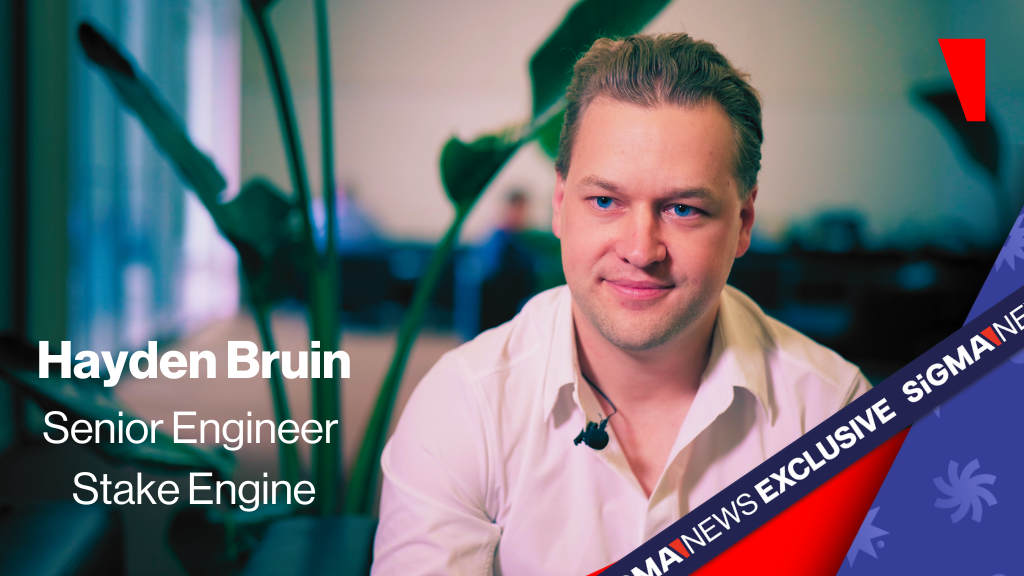
When Senior Engineer Hayden Bruin sits down for the interview during ICE Barcelona, he admits this is not just his first SiGMA interview, but his very first industry conference. “When you walk through the doors, it’s very overwhelming… it’s like you walk into an actual casino,” he laughs, describing the lights, sound and constant chatter on the show floor.
From sportsbook to million-bets-per-second infrastructure
Bruin’s route into iGaming is anything but conventional. “My background in iGaming … I don’t have much, which is cool,” he says, recalling how he starts roughly four years ago, initially working on Stake.com’s sportsbook product. Handling “so many dynamic odds and events happening” at scale proves a perfect training ground for what comes next.
Today, he helps build infrastructure that processes “over a million bets per second,” a challenge he describes as less about clever shortcuts and more about relentless iteration. “We constantly monitor our platform, we are always watching it,” he explains, noting that true scale comes from watching how users behave during peak moments and then surgically stripping out inefficiencies rather than pursuing premature perfection.
Why ‘perfect from day one’ is the wrong engineering mindset
Asked what developers often get wrong about scalability, Bruin does not hesitate: chasing perfect architecture too early. “When people try to build platforms, they try to do it perfectly to start with and it’s just totally not the right approach,” he says. Instead, his philosophy is to “grow with your backend, with your frontend” – constantly revisiting real bottlenecks as traffic evolves.
He illustrates this with a tiny but telling optimisation. When a player places a bet, there are only two outcomes: win or lose. “You only need to call the end-round endpoint when you win,” he says. “Previously we had it for both… but we figured out we don’t actually need to do it when you lose.” That small change removes unnecessary calls and makes the flow smoother, proof that in high-volume systems, micro-optimisations compound quickly.
Compliance as an engineering problem, not just legal overhead
The conversation turns to one of the industry’s thorniest topics: compliance. With RNG certification, responsible gaming features and KYC requirements diverging across markets, Bruin sees this less as a legal chore and more as an engineering challenge, especially as Stake and Stake Engine target more regulated jurisdictions.
To keep developers moving, his team starts by pushing compliance upstream into the creation process. When a developer submits a game, “we have a list of guidelines you follow,” he says, including “all the social wording, words that you can’t use and good replacements.” By the time a title reaches review, much of the heavy lifting is already done, letting reviewers “tick off items very quickly.”
Looking ahead, Bruin expects automation to go much further. He envisages “some sort of AI solution where the AI plays the game and then ticks stuff off,” treating compliance testing as another repeatable workflow rather than a bottleneck that slows launches to a crawl.
Rethinking access: from closed networks to open platforms
Historically, getting a casino game live without the right contacts has been brutally difficult. “It’s been very hard to get your games on a platform if you don’t have any sort of industry network,” Bruin notes. That traditional gatekeeping is one of the things he believes needs to change most urgently.
On that front, he explains, Stake Engine’s philosophy is to strip out friction for builders as much as possible. “You sign up, there’s no signup fee. It’s just very simple,” he says. “You sign up, you can make a game, you read the documentation and it’s great.” He likens the approach to the App Store: anyone can publish an app, some will succeed, some will not, but the barrier to entry is low.
The goal, he emphasises, is not to favour a certain type of studio but to “give people the chance to put their games in front of people,” whether they are an established supplier or a two-person team with a fresh idea.
Data, AI and the death of the static lobby
Another area where Bruin believes the industry is overdue for change is analytics. In his view, that lack of feedback has slowed innovation, forcing developers to design almost in the dark. Stake Engine is pushing in the opposite direction. “Every five minutes you can see what is happening on your game,” he explains, from which modes players spend on to what features actually drive engagement. With that kind of cadence, studios can bring learnings from one release straight into the next.
For Bruin, AI and recommendation engines are natural extensions of this. At the pace games are being shipped, he argues, “the old model of having a homepage and you’ve got a bunch of categories is obsolete.” Instead, he expects personalised surfacing to dominate: players will be “shown games that they might like to play,” reshaping the casino lobby into something far more dynamic – and demanding – from an infrastructure standpoint.
First conference, steep learning curve
Despite the intensity of the discussion, Bruin keeps circling back to how new all of this feels from a personal standpoint. “When you walk through the doors, it’s very overwhelming… but it’s so cool. I absolutely love it.”
By the end of the interview, Bruin jokes about being “exhausted already” and half-wishing the day would end, but clearly energised by the conversations and possibilities the industry is opening up. In many ways, that contrast captures where iGaming engineering itself is right now: slightly overwhelmed by complexity, but more excited than ever to build what comes next.
Stay in the loop and join the biggest iGaming Community in the world with SiGMA’s Top 10 news countdown. Subscribe HERE for weekly updates from the world’s iGaming authority and exclusive subscriber-only offers.


