


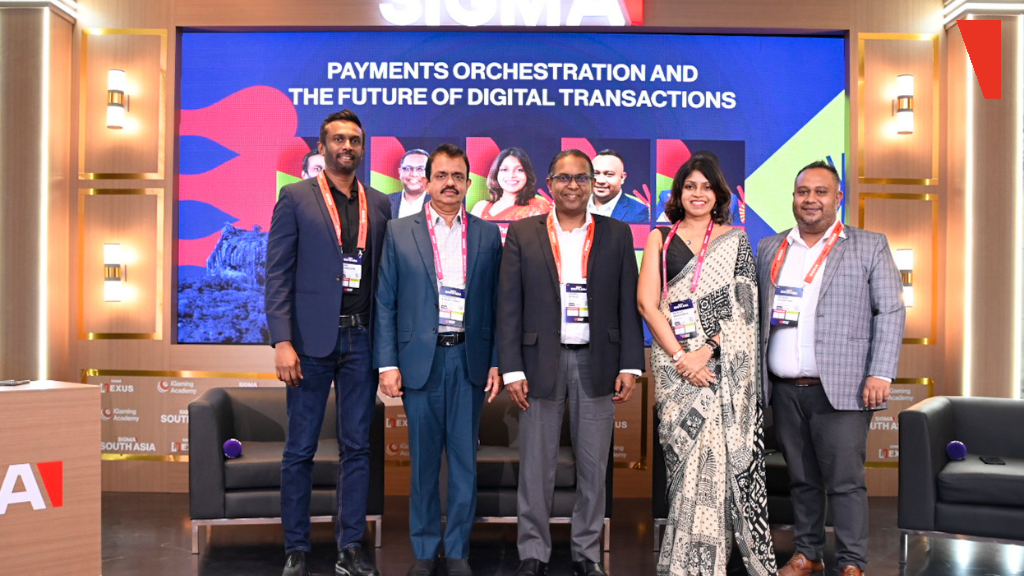
The SiGMA South Asia Summit in Colombo, hosted at the Lumina Ballroom at Cinnamon Life, brought industry leaders together for a forward-looking discussion titled “Payments Orchestration and The Future of Digital Transactions”. The panel discussion took place on December 1st and consisted of five influencers within the financial ecosystem of the region. These included Mario Gooneratne, Chief Executive Officer of LinearSix; Channa de Silva, Chief Executive Officer of LankaPay; Mahesha Amarasuriya, Director of Mastercard Sri Lanka; Manula Ekanayake, Head of Payments and Cash Management from DFCC Bank PLC; and Dharmasri Kumaratunge, Non-Executive Director at Union Bank of Colombo. Their insights offered a comprehensive view of how payments orchestration is maturing and why it is becoming central to operational efficiency and financial empowerment across South Asia.
Transforming payments infrastructure
The conversation opened with a clear message. The increasing number of digital payment options and the growing number of digital currencies, digital payment methods, and digital customer Business requirements have created a clear need for a structured orchestration system for digital transactions. The speakers at this conference all indicated that companies are no longer using standalone digital payment stacks; instead, they now need to consolidate their digital payment processing capabilities due to the ability to process payments on multiple gateways and to process payment settlements through multiple settlement channels.
According to Mario Gooneratne, the demands of customers have significantly changed the landscape for organisations seeking regional and global presence. With a rise in customer expectations for seamless transaction execution and convenience across multiple devices, organisations will need to build infrastructure that allows for card payment acceptance through payment card networks, as well as for acceptance of payments via mobile wallets, banks, and any other digital means.
Real-time performance and operational clarity
Channa de Silva elaborated on the strategic importance of real-time settlement frameworks, noting that Sri Lanka has already made meaningful progress in this direction through various national payment rails. He stressed that the next stage will rely on interoperability combined with intelligent routing. Organisations stand to gain from systems that automatically select the most efficient payment path, manage risk with greater accuracy, and reduce reconciliation bottlenecks.
The discussion also addressed regulatory fluidity in the region. De Silva acknowledged that regulators are increasingly supportive of innovation, provided operators maintain transparency and robust compliance. Payments orchestration can offer this transparency by consolidating data flows and enhancing visibility across all transaction types.
Empowering inclusion and cross-border activities
Financial Inclusion was a core focus of today’s conversation; Mahesha Amarasuriya noted that through increased adoption of digital payments within Sri Lanka, many consumers continue to experience difficulties accessing these services. Ms Amarasuriya further explained that Mastercard believes procuring a means of Orchestration is essential for enabling smaller merchants and financially excluded communities to participate more fully in formalised Financial Systems by reducing high costs associated with their ability to create accounts. As such, Orchestration allows people and businesses who were previously restricted by traditional banking methods, and therefore, opens up opportunities for them.
Various players are working on improving Cross-Border Payments, and there is still much room for growth and innovation in this area. Despite the large number of players in this space and the advancements that have been made over time, the current state of Cross-Border Payments is still costly to merchants due to fees associated with sending/receiving or holding money, and slow turnaround times make Cross-Border Payments significantly less accessible for merchants and consumers. The panellists agreed that orchestration frameworks capable of supporting multiple corridors, currencies, and partner networks can bridge these longstanding gaps, making cross-border engagement more affordable and dependable.
Banking sector readiness
Manula Ekanayake provided the perspective of a central commercial bank, explaining how DFCC Bank PLC is recalibrating its payment operations to remain competitive. He noted that the banking sector recognises the strategic value of orchestration, particularly in strengthening cash management services and improving client retention. The ability to handle multiple payment streams with consistency and security is now considered a differentiator in the corporate banking landscape.
Dharmasri Kumaratunge expanded on this, pointing out that banks must be agile if they wish to serve evolving customer expectations. He underlined that orchestration supports this agility by enabling better fraud management, stronger compliance checkpoints, and enriched data insights, all of which contribute to stronger customer trust.
A maturing payments landscape
Collectively, the discussion signalled that Sri Lanka and South Asia stand at the threshold of a more integrated digital payments era. Orchestration is emerging as the backbone of this progress, enabling speed, scalability, and improved user journeys. The panellists were aligned in their view that collaboration between regulators, banks, fintech innovators, and global networks will be vital for sustaining momentum.
As the summit continued, it was clear that the region’s payments industry is preparing for a future defined by choice, efficiency, and accessibility. With leaders such as Gooneratne, de Silva, Amarasuriya, Ekanayake, and Kumaratunge driving forward these conversations, the outlook for digital transactions is set on a trajectory of meaningful, structured growth.
For more insights and the latest updates from the SiGMA South Asia Summit, visit the SiGMA website at https://staging.sigma.world.


