


How data and AI are shaping esports future - Part I

The esports industry is experiencing transformation driven by data analytics and artificial intelligence (AI). These technologies are now integral to competitive gaming, from grassroots tournaments to professional leagues. According to The Business Research Company, the global esports market reached $2.53 billion in 2024 and is projected to grow to $4.8 billion by 2025, reflecting a compound annual growth rate (CAGR) of over 19 percent. In parallel, the AI in sports market was valued at $7.73 billion in 2025 and is expected to reach $39.65 billion by 2032, with a CAGR of 26.3 percent.
AI in esports now goes beyond basic stats tracking. Machine learning algorithms analyze player behavior, movement patterns, and in-game decisions in real time. Cloud-based AI solutions have become dominant, accounting for 55.6 percent of the sports AI market share in 2025. Data interpretation and analysis represent 40.6 percent of its applications, highlighting a shift toward more advanced, real-time performance insights.
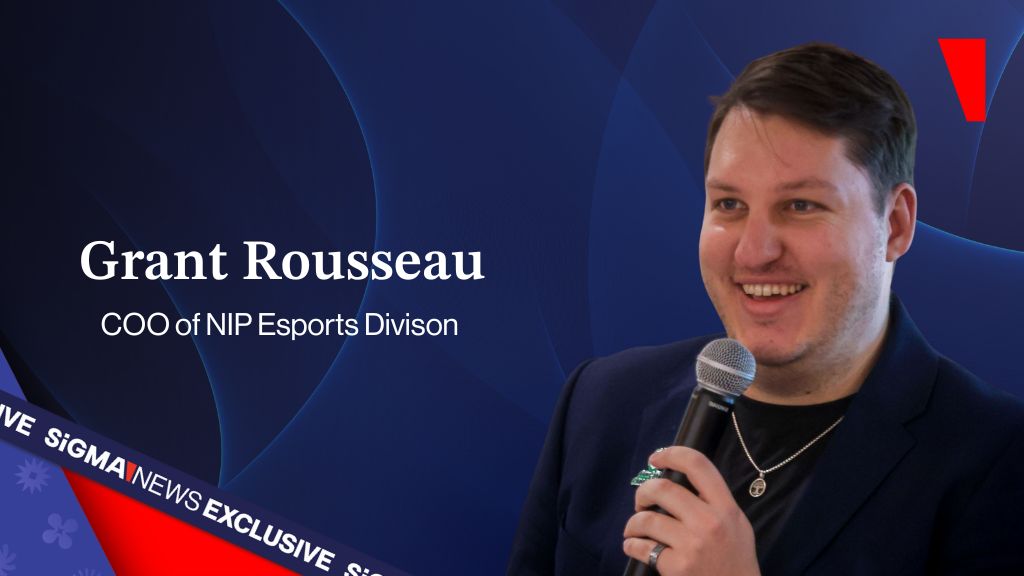
NIP Group, the UAE-based digital entertainment company backed by the Abu Dhabi Investment Office (ADIO), has recently appointed Grant Rousseau as the Chief Operating Officer (COO) of its Esports Division. Rousseau previously worked as the Global Director of Esports at Team Falcons for the past two years. During his tenure, he led the organisation to two Esports World Cup club titles and helped expand Team Falcons’ roster to over 20 different game titles.
In an exclusive interview with SiGMA News, Rousseau shared insights on the evolving esports scene, spotlighting the MENA region’s rapid rise and the shift toward holistic talent development. He discussed the mixed impact of tournament saturation, the Olympics’ potential to legitimise esports, NIP’s strategy across diverse markets, and how emerging tech like AI is shaping competitive and operational edges.
MENA’s emergence as esports powerhouse
SiGMA News: How do you see the Middle East’s rapid emergence as an esports powerhouse influencing global competitive structures, and what factors beyond investment are driving this transformation?
Grant Rousseau, COO of NIP Esports Division: When we talk about the MENA region, Saudi Arabia is a part of that, and the UAE are the two main players. Saudi Arabia, previously with Falcons but also with what they’re doing with NIP and other teams, with the World Cup, with the Nations Cup, gaming in general, publishing games, etc., it’s very clear that they recognise gaming and esports can be a substantial growth metric for their country’s GDP. That recognition means they’re willing to commit everything to it and have the capital funds to do so.
UAE, together with NIP, is a very exciting moment because it’s allowing us to work very strongly there as a leading esports organisation in the UAE, and it’s good to see them pushing into it alongside Saudi Arabia. So yeah, it’s a very significant development that they’re doing this.
“It’s very clear that the MENA region recognises gaming and esports as a substantial growth metric for their GDP and they have the capital to back it.”
– Grant Rousseau, COO of NIP Esports Division
These are very hot countries. The ability to play traditional sports or be involved in traditional sports is more difficult because of the heat and temperature. Combine that with a group of people who are extremely competitive, they’re very naturally competitive people, the Saudis and the Emiratis, as I’ve learned. With football, we’ve seen that with other sports, and how much they love competition.
So, they want to be involved in competition, but being directly involved in traditional sports isn’t easy. Esports allows you to compete at a high level, allows you to be competitive, but it’s something everyone can be involved in. So, it’s of massive benefit to the population to provide that focus and to provide something they can really channel a lot of energy into and be a force for good in the form of gaming and esports.
As I said, it’s beneficial for economic growth, especially for GDP. They’ve recognised an industry they can use, they can lead, and they can dominate, which is brilliant. But one of the biggest factors is that it’s brilliant for their population, and that’s not talked about enough.
Tournament saturation and sustainability
SiGMA News: The Esports World Cup’s back-to-back success highlights the growth of mega-tournaments, but how sustainable is the current tournament saturation across multiple titles, and are we approaching oversaturation in certain regions?
Rousseau: Well, it’s very game-by-game. So yeah, let’s talk about some of the games. Let’s talk about Counter-Strike or Dota. For the more open circuits, there is a lot of saturation. There are a lot of third parties that have moved in and set up shop. And they are most of them are brilliant, amazing setups, and it’s really good for the industry. At the same time, some limits are being reached. You are unfortunately now starting to see moments where some production groups might not get the attraction of the teams they want because it clashes with another game or another tournament.
The infamous RMR system of Counter-Strike has been an example of something people are trying to figure out. But even in Dota, we’ve worked it out, so the Counter-Strike players at NIP were on the road for like 270 days or 260 days. So, almost 78 percent of the year they’re on the road already. And now you’re adding in the World Cup. Now you’re adding in the Nations Cup. Now you’re adding in whoever else wants to come in.
So, for those two games, it’s fair to say there’s saturation. But ultimately, more competition is never a bad thing. It just reaches a point where we’re going to have to choose what we compete in. And that’s not a bad thing for us. That’s a great position for us to be in.
For the more closed circuits or smaller titles, it shouldn’t be oversaturated. The World Cup didn’t necessarily clash with schedules. Trying to get all of the titles into one timeframe is not easy for them because everyone’s schedule is different.
But ultimately, outside of two or three games like Counter-Strike or Dota, it’s been the thing that helped the scene survive and grow and return. You could talk about small games like StarCraft, which EWC probably saved. Aspects of the fighting games were great. But even games like Rocket League and such, which do have established major events, have just added that extra level. So, it’s been very successful what EWC and the Nations Cup are going to do. And if it’s balanced in the bigger games, it’s all a good thing.
This is the 2025 Esports World Cup in numbers 📈
— Esports World Cup (@EWC_EN) September 3, 2025
• 2500+ competitors 🆚
• 3 Million visitors 🏟️
• 800,000 pieces of content shared 📲
• 8 Billion impressions across the EWC social channels 📊
And much much more! pic.twitter.com/89yVAqQyHD
SiGMA News: The Olympics are also happening in 2027 in Riyadh. Do you want to see esports in other regions too? Like in the North American region or the South American region?
Rousseau: Esports Olympics is almost a different conversation because I think the Nations Cup and the Olympics are very similar offerings. The difference with the Olympics, if it happens, because there’s a long way to go still, but assuming it does, it adds legitimacy to esports that I don’t think anything else has been able to provide. The ability to earn an Olympic medal will reach non-esports or non-endemic businesses, companies, fans, and people who are going to be interested, whatever it may be. So, it’s going to hit a whole new wave of audience that traditional esports can’t reach. And to be honest, we’re not always trying to reach them.
If we sit here every day fighting for the argument, “Are we a sport? Are we a sport?”, no one wins. So, we don’t need to have that debate but having the Olympics will add a level to that, regardless.
Be part of the action at SiGMA South Asia, 30 Nov – 02 Dec 2025. Colombo becomes the heart of gaming as 5,000 delegates, 100+ speakers, and 1,000 operators gather under one roof. With high-value traffic, game-changing insights, and unforgettable networking, this is where new markets meet new horizons.


