


Is poker entering a new golden era driven by streamers and live events?

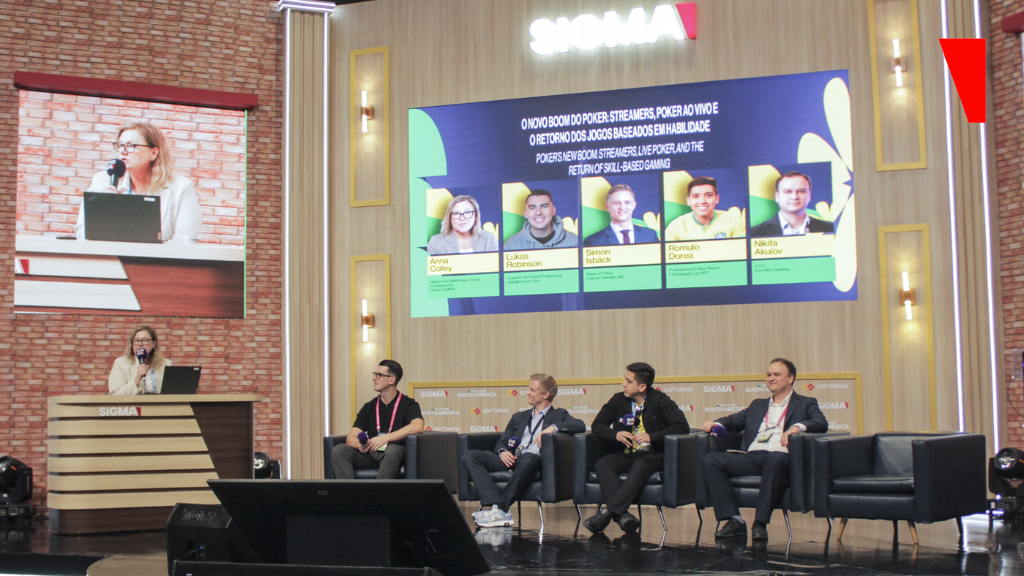
During BiS SiGMA South America 2026 in Sao Paulo, hosted at the Transamerica Expo Center, the Paulista Stage welcomed industry leaders and players for the panel Poker’s New Boom: Streamers, Live Poker, and the Return of Skill-Based Gaming. As poker experiences a resurgence across Latin America, the session explored how the game is being reshaped by digital content, live experiences, and a renewed focus on skill.
The panel featured Lukas Robinson, Professional Poker Player, Simon Isbäck, Head of Poker at Cubeia Sweden AB, Romulo Dorea, Professional Poker Player and WPT Ambassador, Nikita Akulov, Chief Customer Officer at EvenBet Gaming and Anna Colley, Head of SiGMA Poker Tour & Conferences at SiGMA Group.
Together, they examined how live broadcasts, influencers, and online platforms are driving poker’s growing popularity, repositioning it at the crossroads of entertainment, sport, and performance. The discussion also highlighted the role of live events and streaming in engaging new audiences, as well as the increasing appeal of poker as a competitive, skill-based discipline in today’s gaming landscape.
A global rise
While comparisons to the early 2000s poker explosion are inevitable, the panel struck a more measured tone.“I think it’s easy to look back at 2003… and hope to get back there,” said Isbäck, referencing the era sparked by Chris Moneymaker. “But no online game… has ever had a boom and then 20 plus years later had a bigger boom.”
Rather than a repeat of history, the consensus pointed toward a shift in consumption. Poker isn’t simply growing, it’s evolving into a different kind of product altogether.
Engines of growth
For Dorea, the surge in markets like Brazil is deeply tied to content and accessibility. “I have never seen poker booming as much in Brazil over these last 16 years,” he said, attributing the rise to a change in approach. “Instead of focusing on talking to the pros… [we’re] focusing on talking to any person that thinks poker is interesting.”
This broader appeal is critical. “The game cannot grow if we don’t get new players to it,” he added. Even cultural figures like Neymar are playing a role in expanding poker’s reach. “Whatever Neymar puts his eyes into… it really becomes big,” Dorea noted, highlighting the power of mainstream influence in driving curiosity toward the game.
While poker has long been associated with luxury and high stakes, today’s growth is increasingly tied to accessibility and experience. Robinson pointed to live events as a key driver, “I think it’s the experience… If people sign up and they have a bad experience… they won’t come back.”
Instead, events are evolving into holistic entertainment environments. “It’s not just poker, it’s the experience,” he said, highlighting the importance of atmosphere, community and enjoyment.
Skill or luck?
The enduring debate over whether poker is a game of skill or luck also took centre stage.
“I would say long-term it’s 100% skill,” said Dorea. “But the luck factor actually makes the game be more popular because anyone is able to win.” That accessibility is crucial. Early wins can spark interest and emotional investment, drawing players deeper into the game.
While influencers and streamers are highly effective at attracting new audiences, retention remains the industry’s biggest challenge. “There is definitely more players that have been attracted by influencers right now,” said Akulov. “But… we collectively need to learn to retain players as well.”
That responsibility falls on platforms and operators to deliver seamless user experiences and long-term engagement strategies. A key factor, he explained, is progression, “Players want to feel the sense of progression… while the skill ceiling remains high.”
The dopamine factor
Another shift highlighted during the panel is how poker is perceived by the average player. “For some reason, I personally feel like it should be seen as a hobby,” Robinson said. “You go to the cinema… you don’t expect any money back in return and that’s the way poker should be seen.”
This reframing supports a healthier ecosystem, where enjoyment and experience take precedence over profit for the majority of players. Modern content strategies are also reshaping how poker is consumed, particularly among younger audiences. “We are all addicted to dopamine,” Dorea said candidly. “When I do a short, I always try every two or three seconds [to show] something new happening.”
Poker’s inherent structure—cards revealed in stages, makes it ideal for suspense-driven storytelling. “It always starts with you getting your hand… then the flop… then the turn… then the river,” he explained, highlighting how naturally the game fits short-form, high-engagement formats.
A new era
As poker continues to evolve, its latest boom signals more than just a resurgence, it reflects a transformation in how the game is consumed, experienced, and understood. With the convergence of live events, digital platforms, and creator-driven content, poker is carving out a renewed identity that blends competition with entertainment.
Stay tuned for more in-depth coverage, exclusive interviews, and key highlights from BiS SiGMA South America 2026 as we continue to bring you the biggest stories from the event.


