


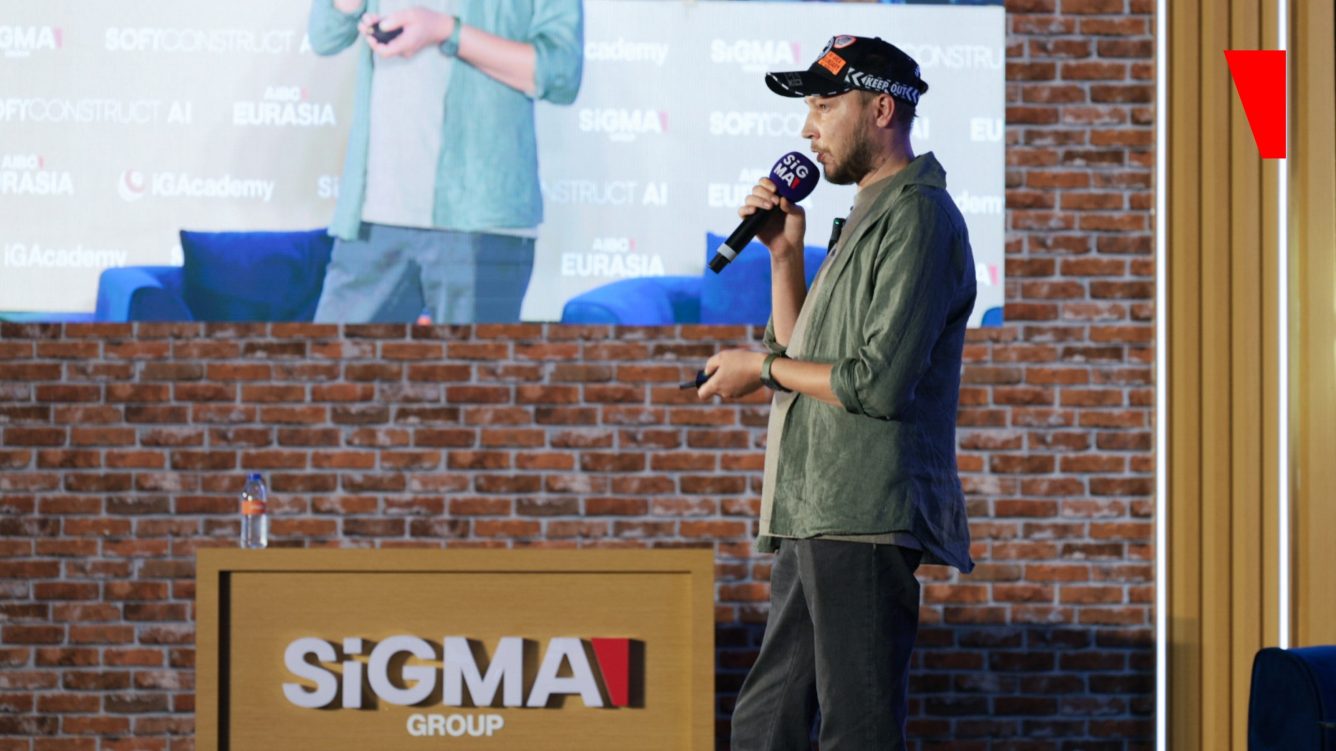
Alex Riddick, Founder and CEO of Riddick’s Partners, spoke at AIBC Eurasia 2026 this week on the Evolution of Affiliate Networks in 2026. His keynote was focused on the market’s practical logic – why the classic affiliate network model stopped being sustainable, where value is now created and which infrastructure requirements have become the baseline today.
AIBC Eurasia 2026 is powered by SoftConstruct AI and taking place at the Festival Arena in Dubai.
Who is Alex Riddick?
Alex Riddick is an entrepreneur from Omsk who, at 21, launched an innovative taxi service where drivers could use mobile apps – long before Uber. In 2024, he founded the affiliate network Riddick’s Partners. The company positions itself as a team with expertise in affiliate marketing and performance-driven approaches. On 09 February, as part of this year’s Eurasia Awards, Riddick’s Partners received an award for “Best Multi-Vertical Affiliate Network”.
When the market moved away from affiliate networks
At the start of his talk, Riddick suggested looking at the market as a genre history: affiliate models existed well before the current cycle, but he framed the era of “traffic networks” as spanning 2014-2026. As early milestones, he cited Prodigy (1989) and CJ (late 1990s), then explained how the intermediary model relied on high margins: the network connected the brand and the affiliate, handled communications and payments, and took a substantial share.
The turning point came when direct advertisers began building relationships directly. Conferences and regular meetings made contacts easier to access, and direct deals became the norm. That was when a network stopped being a mandatory link in the chain unless it delivered a clear improvement in quality and speed.
“Why work through a network and earn less if you can work directly and earn more?” is how Alex summarised the motivation of direct market players.

Why affiliate networks stopped being worth it
The key criterion is added value that can be measured in money and growth. If a network does not bring new, high-quality audiences, does not provide technological and operational support, does not accelerate scaling, and does not reduce risk, its commission becomes a “habit tax”.
Riddick used his own career experience as an argument: at one point, from the product side, he cut network commissions because he did not see value comparable to direct arrangements. This is why the market split: some teams upgraded their capabilities and moved closer to a performance-service model, while others lost their economics by continuing to sell a посредник role.
In 2026, Alex argued, the networks that survive are those that can prove they outperform a direct contract: they speed up launches, protect data, improve funnel quality, and manage risk.
Infrastructure, support and trust
The practical part of the talk focused on the technology foundation. Using his own example, Alex explained how to build infrastructure that can withstand scale and meet the expectations of affiliates and brands. Riddick described a journey from attempting to build an in-house solution (with an emphasis on integrations and data volume) to moving to a SaaS platform.
He linked his selection criteria to what directly affects finances and reputation:
- launch speed
- security
- scalability for the team and the number of active affiliates
- flexible commission models
- detailed analytics
- and the support format (SLA).
“When you work with exclusivity, your affiliate must be confident that their data will not be compromised. That is reputation”
In this logic, trust becomes part of the product: affiliates need confidence that infrastructure will not fail at critical moments and that their internal metrics are protected. This, Riddick said, is the new baseline for 2026 – fast response and data security as core standards.


The affiliate-network format in 2026
In the final part, Riddick described a shift from a narrow intermediary role to a B2B provider model, where the network becomes a dense layer inside a broader solution stack. He compared the process to product-building: the idea needs to be broken into components, processes rebuilt, and a unique setup created rather than copying competitors.
In this framework, value moves into expertise, processes and trust – the ability to work with different sources, understand unit economics, make product recommendations, and protect reputation on short cycles.
The speaker also emphasised model maturity: businesses should be measured by metrics that genuinely drive revenue and development, and processes should be redesigned so they perform better than the market – or fundamentally differently.
Table Mountain has the views; we’ll bring the deals. SiGMA Africa lands in Cape Town from 03–05 March 2026 and draws 3,000 minds to a rising frontier of innovation and ambition. It’s shaping the continent’s future. Be there.
