


Behind the AI pitch, investors are asking harder questions

The venture capital market has never committed more money to artificial intelligence. PitchBook data shows that AI startups pulled in $270 billion in 2025, the first year the sector absorbed more than half of all venture capital deployed worldwide. Yet for founders betting that an AI label alone will open doors, the pitch room is becoming a harder place to be.
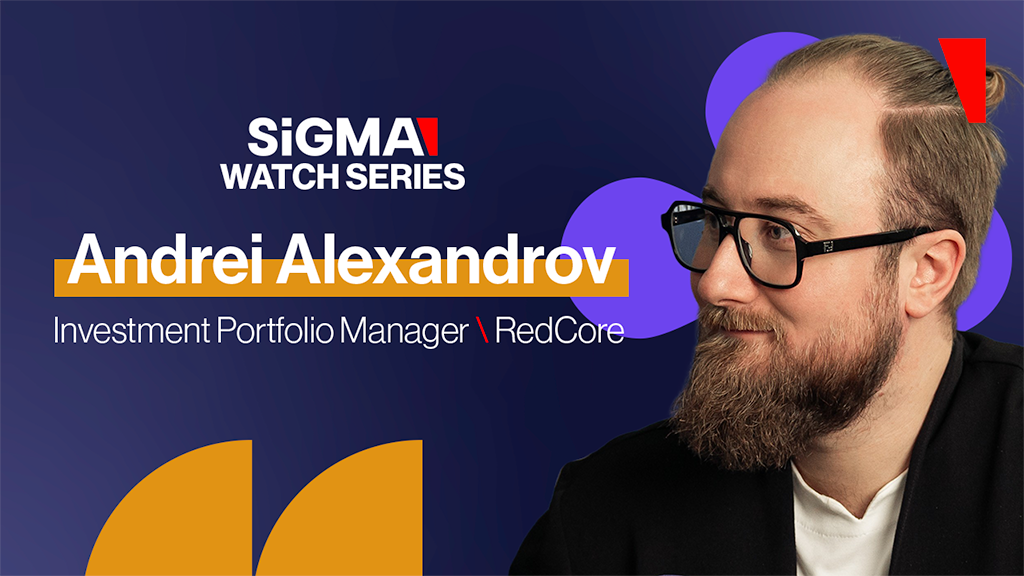
Speaking exclusively with SiGMA News, Andrei Alexandrov, Investment Portfolio Manager at RedCore, pointed to a growing disconnect between the volume of AI-branded pitches entering the market and what investors are actually looking for when they evaluate them.
“AI is not a panacea for everything,” Alexandrov said. “It is a comprehensive tool, but nothing more. You can hammer nails with a microscope, but obviously it is much smarter to use it another way.”
The product has to stand alone
For Alexandrov, the first question he asks of any AI-enabled product is whether it holds up without the technology. A product that cannot answer that question, he said, has a fundamental problem that no AI feature can fix.
“Your product must be complete without AI, and AI can make it better, or faster, or reduce your costs,” he said. “But it does not need to be the centre idea of your product.”
He noted one exception: companies whose core business is AI itself. For everyone else, the technology should serve the product rather than define it.
What investors are screening for
Beyond the AI question, Alexandrov described the criteria that determine whether a startup moves forward in his assessment. Team quality remains a baseline requirement. But he placed equal weight on how well a founder understands the mechanics of what they have built.
“The team is a cornerstone of every project,” he said. “Your project simply cannot evolve without a good team.” On the product side, his standard is equally clear. “All its components need to be interconnected. They need to be clear, understandable, and needed for the market.”
That level of preparedness, he argued, is what separates a fundable founder from one who is not ready for the conversation. “You need to understand what your project is, what it consists of, how the cogs are running in your product, because an investor will not invest unless you make an advocacy of it. You need to be the expert, more than the investor, in your own product.”
His summary of what he is ultimately looking for was direct. “We look for professionals. We do not look for the guys that just want money.”
On investor rejection
For founders navigating rejection, Alexandrov offered a distinction that is often overlooked. A no from one investor is not necessarily a judgement on the product.
“If you get a no, especially the first time, it is not necessarily about your product,” he said. “You may simply be out of focus for the investor you approached. Maybe just look for another investor.”
Different funds operate with different theses and different stage preferences, and Alexandrov said a mismatch on any of those points can produce a rejection that has nothing to do with the quality of the business.
At the same time, Alexandrov was candid about the cases where rejection does reflect a gap on the founder’s side. Founders who cannot speak fluently about their own product, he said, are not ready to be in a funding conversation regardless of the underlying idea.
“When the product you made becomes a norm, it stands not for a barrier. It stands for an opportunity to make new ideas in this market.”
– Andrei Alexandrov, Investment Portfolio Manager at RedCore
The sectors drawing attention
Looking ahead, Alexandrov identified regulatory technology as the area he expects to attract sustained investment over the next two to three years. The RegTech market stood at $24.34 billion in 2025 and is projected to reach $112.1 billion by 2033, growing at 21.1 percent annually, according to Grand View Research.
“RegTech is rising and it becomes a necessity because of the emerging markets and the changes,” he said. “I think the next two, three years, RegTech is on the rise definitely.”
Alongside RegTech, he pointed to AI infrastructure as the second area drawing serious capital, specifically the systems built to deliver measurable accuracy and reliable prediction. “There is a race between AI projects for clear metrics and clear predictions,” Alexandrov said. “When the market emerges so fast, it definitely needs attention.” For founders operating in crowded markets, he offered a final point of perspective. Saturation, in his view, is not a reason to step back but a signal to think differently.
A new frontier rises beneath the skyline of São Paulo. From 06–09 April 2026, BiS SiGMA South America transforms LatAm’s gaming capital into a hub of innovation, bold talks, and billion-dollar opportunity. Don’t sit this one out.


