


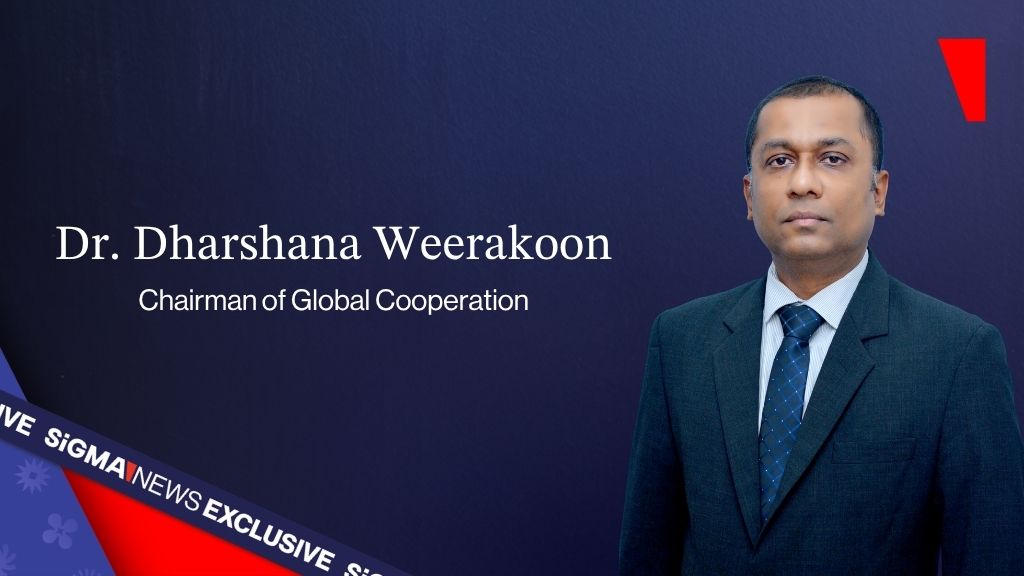
Sri Lanka was no longer a minor player in the Asian gaming narrative. A $1.2 billion integrated resort has already opened at Colombo Port City, the Gambling Regulatory Authority has been in effect since December 2025, and the gaming industry is expected to reach $410 million by 2026, putting the island at a once-in-a-generation crossroads. The industry’s potential to expand was not the question. It was whether Sri Lanka would grow it wisely. In an interview with SiGMA News, Dr. Dharshana Weerakoon, Chairman of Global Cooperation Private Ltd and a well-known tourist and hospitality strategist, discussed the options, dangers, and unique opportunity that lay ahead.
Regulation before revenue
The gaming sector in Sri Lanka operated in a gray area for many years, neither quite legal nor entirely illegal, and frequently poorly understood. There were few licenses, regulations were stitched together from antiquated legislation, and most serious investors avoided the market since they didn’t know what they were getting into. With the establishment of the Gambling Regulatory Authority, which was codified as Act No. 17 of 2025, that started to change.
“This transition represents a foundational shift rather than a routine policy adjustment. The introduction of a formal Gambling Regulatory Authority signals a move towards structure, predictability, and international alignment“ he said.
Colombo could already see that signal. The island saw its first fully integrated resort footprint with the opening of City of Dreams Sri Lanka by Melco Resorts and John Keells Holdings. Weerakoon saw the resort model as essential to the country’s ambitions, with gaming sitting inside a layered ecosystem of hospitality, dining, entertainment, and conference facilities. But he was careful not to oversell the regulatory moment alone.
Weerakoon noted, “Regulation alone will not guarantee success. The effectiveness of this shift will depend heavily on disciplined implementation particularly in maintaining licensing standards, avoiding over-saturation, and ensuring policy consistency over time.”
Paradise has a price
Sri Lanka’s beaches and natural beauty had long served as tourism magnets, and the idea of threading integrated gaming resorts into that landscape carried obvious appeal for foreign investors. But Weerakoon warned becoming solely a licencing jurisdiction.
“If operators primarily target offshore markets, the direct benefits to the domestic economy, employment, supply chain development, and tourism receipts, can be minimal.”
Dr. Dharshana Weerakoon, Chairman of Global Cooperation (Pvt) Ltd
Weak oversight in iGaming, particularly on financial integrity and responsible gaming, could quietly erode a country’s broader tourism positioning long before the numbers showed the damage.
Structure before rush
India’s tightening grip on online gaming regulation Sri Lanka was well-positioned to benefit from regional spillover. But Weerakoon argued the country should resist the temptation to plant a flag as a low-tax destination and wait for operators to arrive.
Weerakoon advised, “Taxation should be competitive but stable, as predictability is often more attractive to serious investors than short-term incentives.” He stressed that operators couldn’t just exist on paper anymore. They would need to demonstrate a genuine economic presence with offices in Sri Lanka, local personnel on the ground, and daily operations integrated into the nation’s larger hospitality sector in order to be regarded seriously.
Diversify or destabilise
The integrated resort model tempted developers with big VIP numbers. High-rollers, junket operators, premium mass. But Weerakoon argued for balance.
“Responsible gaming should be treated as a core operational principle rather than a regulatory obligation. In markets like Sri Lanka, where the industry is still evolving, long-term success will depend significantly on public trust and brand integrity.”
The numbers already told a story. Between 60 and 70 percent of Sri Lankan casino users now play online, with only 30 to 40 percent attending physical casinos. Any revenue strategy that ignored that structural shift would find itself chasing the wrong audience. A diversified revenue mix, which includes mass market alongside VIP, offers resilience against shocks.
Public risk, private gain
Sri Lanka’s government had been eyeing special economic zones and large-scale tourism infrastructure as vehicles to attract foreign capital. Public-private partnerships were the obvious mechanism. But Weerakoon applied a sharp lens to the risks embedded in these structures when casinos, hotels, and infrastructure financing got bundled together.
His primary concern was sovereign risk creep. “Overuse of sovereign guarantees, which can shift commercial risk onto the public sector. A robust governance framework, realistic feasibility studies, and clearly defined risk-sharing structures are essential to mitigate these challenges.”
Quality over quick growth
Sri Lanka’s regional neighbours offered lessons: Singapore’s duopoly model, Malaysia’s measured approach to gaming taxation, and the Philippines’ mixed experience with rapid POGO expansion all carried lessons that applied directly to Colombo’s current moment. For Sri Lanka, Weerakoon suggested regulatory discipline and controlled market entry.
“Limiting the number of licences while maintaining high standards helps preserve long-term value, ensures better oversight, and builds investor confidence.” He added that consistency in policy and enforcement was often what distinguished markets that attracted serious, long-horizon investors from those that attracted opportunistic ones.
More than a gaming market
Sri Lanka’s gaming moment is influenced by three forces: a post-crisis economy seeking fresh development engines, a tourist industry aiming for $5 billion in revenue and 3 million visitors, and a worldwide business ravenous for regulated, high-value Asian destinations.
Weerakoon emphasised, “The framework is being established at a stage where global best practices are well understood. With a measured and strategic approach, the country has the potential to build a well-regulated, tourism-integrated, and globally credible gaming ecosystem.”
A new frontier rises beneath the skyline of São Paulo. From 06–09 April 2026, BiS SiGMA South America transforms LatAm’s gaming capital into a hub of innovation, bold talks, and billion-dollar opportunity. Don’t sit this one out.


