


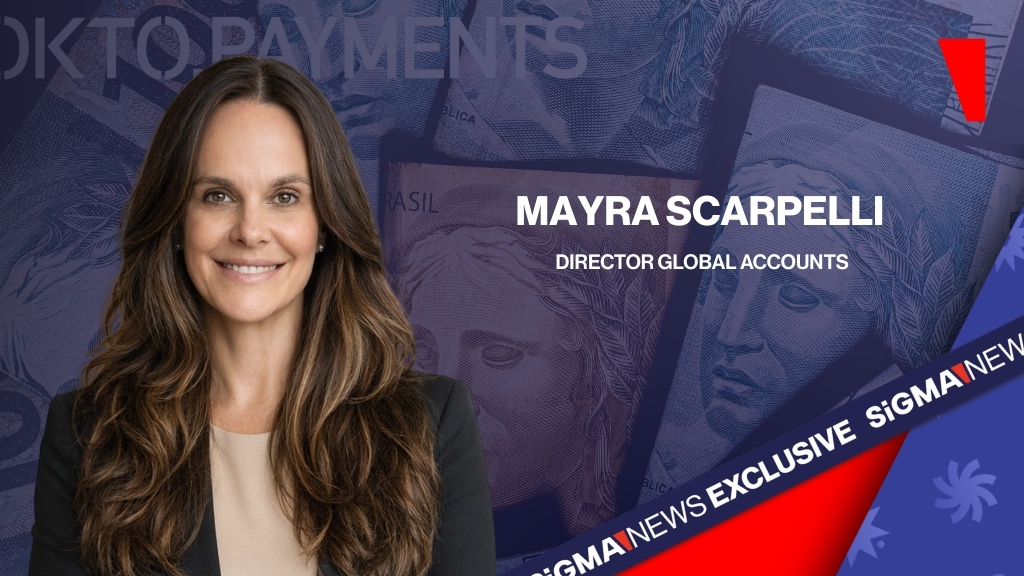
Exclusive: Mayra Scarpelli on PIX and payment complexity for foreign operators

Brazil has experienced major changes in recent years, and one of the most significant developments has been the arrival and popularisation of PIX. The instant payment system created by the Central Bank has become dominant in the country and has completely changed the way Brazilians make their daily payments. One of the groups benefiting from the convenience of PIX is online players, who deposit and withdraw money on platforms much more easily and quickly.
For the Brazilian user, paying with PIX is something extremely natural. The method is instant, widely used and reduces many of the frictions that used to exist with cards or traditional transfers. In just a few seconds, the player can make a deposit and start playing. But behind this simplicity, the reality is very different for international operators.
According to Mayra Scarpelli, Account Director at OKTO Payments, in an exclusive interview with SiGMA, while PIX simplifies the user experience, it also creates new operational and compliance challenges for foreign companies that want to operate in Brazil. The system requires a highly complex local infrastructure, integration with financial monitoring systems and rigorous identity verification and anti-money laundering processes. In other words, what seems simple for the player involves great technical complexity behind the scenes.
This is precisely where companies specialised in payment infrastructure come in. OKTO Payments, for example, works to reduce this complexity for global operators by offering solutions adapted to the Brazilian ecosystem. The company develops localised payment infrastructure, with integrated compliance mechanisms, real-time financial monitoring and technological solutions focused on security and authentication processes. Among these solutions is Biometric Pix, a system that adds biometric verification at the moment of the transaction without harming the user experience.
The challenge of balancing speed and security
According to Mayra, instant payments have brought a new standard of expectation for players. Today, many users expect deposits and withdrawals to be processed within seconds. However, at the same time that speed has increased, concerns about fraud, money laundering and practices such as multiaccounting have also grown, when a single user creates multiple accounts to obtain unfair advantages.
This scenario has created one of the biggest current challenges in the industry: how to maintain the speed of transactions without compromising the financial monitoring required by regulators. The answer, according to Mayra, lies in the use of advanced technology and real-time intelligence. At OKTO Payments, for example, the approach adopted is called AI-native. This means that artificial intelligence is part of the core of the company’s infrastructure.
“At OKTO Payments, we operate with an AI-native approach, in which machine learning models analyse behavioural patterns, transaction risks and digital identity signals in real time. This allows us to identify anomalies, multi-account behaviours or suspicious activities while minimising friction for legitimate users,” said Mayra.
Solutions such as Biometric Pix further strengthen this security layer. By adding biometric authentication at the moment of the transaction, the system confirms that the person making the payment is truly the account holder, significantly reducing the risks of fraud.
Common mistakes in payment architecture
Even with the importance of payments within iGaming, many operators still make the same mistakes when developing their financial architecture in Brazil. According to Mayra, there are three main ones. One of the most common is treating payments merely as a technical gateway, without recognising that deposits and withdrawals are a central part of the player journey. In iGaming, these moments are extremely decisive for the user experience. A slow or problematic payment process may cause the player to abandon the platform.
Another frequent mistake is relying on limited infrastructure or on just one payment provider. When this happens, any instability can generate transaction failures. The lack of redundancy and intelligent fallback mechanisms can directly impact payment approval rates and the player experience.
It is also common for international operators to try to replicate in Brazil the same payment model used in other markets, especially in Europe. However, the country has its own characteristics that require adaptations and they are essential. The Brazilian player is unique, and the Brazilian ecosystem has very specific characteristics related to PIX, regulatory monitoring, financial reconciliation processes and real-time risk management.
To deal with these challenges, some companies adopt the payment orchestration model. In this type of approach, different payment routes are combined within the same infrastructure. This helps optimise approval rates, reduce failures and improve transaction stability.
The impact of artificial intelligence on financial operations
Artificial intelligence is also transforming the way financial decisions are made within iGaming. Traditionally, many systems operated with fixed rules to detect fraud or manage transactions. Today, more advanced models use dynamic behavioural analysis.
In Mayra’s opinion, this change has a direct impact on three main areas. The first is fraud prevention. With real-time analysis, it is possible to identify suspicious patterns even before a transaction is completed. The second is performance optimisation. Intelligent systems can automatically adjust payment routes, prioritising providers with higher approval rates and lower probability of failure. The third involves risk management and compliance. Artificial intelligence makes it possible to monitor financial activities with much greater precision, facilitating the identification of potentially suspicious behaviour.
In practice, this helps operators offer a smoother experience for players while maintaining high levels of security and regulatory compliance.
The “shock” foreign companies face in Brazil
Many international companies arriving in the Brazilian market experience an initial shock. This happens because Brazil does not function simply as another market within the global payments landscape. In practice, the country has its own financial ecosystem.
The levels of PIX adoption are unique in the world and completely change the dynamics of deposits, withdrawals, financial settlement and reconciliation. In addition, the regulatory environment requires specific controls related to identity verification, monitoring financial flows and transaction traceability. Companies that try to directly apply the same models used in other regions often encounter difficulties operating in the country. For this reason, Mayra, based on her market experience, highlights the importance of working with partners who have deep knowledge of the Brazilian market and local infrastructure.
When it comes to attracting players, many operators focus mainly on the range of games. However, the payment experience carries enormous weight in user retention. For example, a player may initially choose a platform because of the available games, but the decision to continue using the service is usually linked to the quality of the payment experience.
Instant deposits, fast withdrawals and secure transactions are factors that directly influence user trust. For this reason, more and more operators have been investing in advanced payment infrastructure.
“Payments have ceased to be just an operational function — today they are a central part of the user experience and of building long-term trust with players,” Mayra concludes.
This article was first published in Portuguese on 9 March 2026.
Sign up HERE to receive the SiGMA Top 10 news list and the SiGMA weekly newsletter. Stay up-to-date with the latest iGaming news from the world’s largest iGaming community and take advantage of exclusive subscriber offers.


