


BOS warns Sweden is losing ground on gambling channelisation

When Sweden re-regulated its gambling market in 2019, the aim was straightforward: bring gambling into a controlled, taxable system with strong consumer safeguards. Seven years on, the country is still trying to catch up with a basic reality of the internet and, according to the online gambling industry, it is losing ground.
“Channelisation is the mother of all other challenges,” Gustaf Hoffstedt told SiGMA News. “Without doubt, that is the most important challenge in Sweden and elsewhere.”
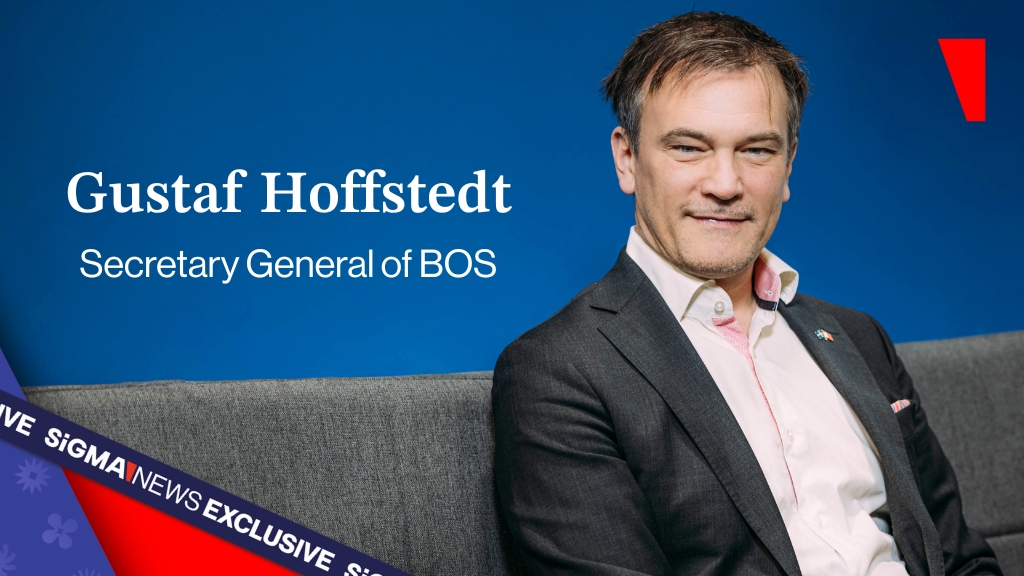
Hoffstedt, a former member of the Swedish parliament, has led BOS, the Swedish Trade Association for Online Gambling, since 2015. The group represents 19 licensed gambling operators and suppliers. “The idea behind the association is to speak with one voice,” he said, towards politicians, the regulator, and other parts of Swedish civil society.
That voice has become louder in recent months, as Sweden prepares to change the scope of its Gambling Act. From 1 January 2027, Sweden is expected to shift from enforcing rules only against operators that actively target Sweden (direction criterion) to a broader approach based on where players are located, making it easier to take action against offshore sites used by Swedish residents (participation criterion).
Hoffstedt supports the change. But he argues it is only part of the answer, and that politicians across Europe keep reaching for the same tool: tougher restrictions, heavier penalties, and higher costs for licensed firms, while failing to make the legal market competitive enough to hold consumers.
The illusion of control
For Hoffstedt, however, Sweden’s struggles are not just a regulatory failure, but a philosophical one. Lawmakers, he argues, keep trying to control consumer behaviour through bans, blocks, and restrictions, instead of accepting that players will ultimately make their own choices online. “We live in mature democracies,” he said during the interview. “Do we really want the government to limit our access to the internet?”
The problem with building digital walls, Hoffstedt believes, is that they rarely hold. “The consumer will always, always find ways to circumvent restrictive measures if they believe the gambling market is more attractive elsewhere,” he said. In other words, when legal options become less appealing, players do not stop gambling: they simply move elsewhere.
A law that made licensing “more or less voluntary”
The problem, Hoffstedt said, was baked in from the start. Under the current framework, he argued, “it is not illegal to accept customers from Sweden, as long as you avoid using the Swedish language and the Swedish currency, the krona.”
That is not much of a barrier in a country with high English proficiency and easy familiarity with the euro. “We are a fairly small country, and as a result, we are quite good at speaking and understanding English,” he said. “We are also fairly experienced in using the euro as a currency, so that is not really a barrier.”
The result, he said, is that “it has been more or less voluntary for operators to have, or not have, a national licence”, which he described as “catastrophic when it comes to safeguarding the licensed gambling market”.
The incoming reform, he believes, could begin to change the incentives, but only if Sweden is willing to enforce it. “Enforcement is key here,” he said. “It really doesn’t matter if we have a law that the prosecutor is not really interested in.”
He laid out a blunt test of whether the new system will bite. “If unlicensed, and therefore illegal, operators realise that offering services to Swedish customers could result in being jailed upon arrival at Stockholm airport,” he said, “with police there to enforce the law, that would be a different story.”
Even then, he warned, Sweden is too focused on building barriers rather than building attractiveness. Lawmakers, he said, keep reaching for “repressive measures”, “punishments more or less”, such as “payment blockings, ISP blocking, DNS blocking” and, now, the participation criterion.
The logic is always the same, he argued: “Create the wall between the licensed market and the unlicensed market.” But, he said, “if the jurisdiction fails in creating an attractive gambling market on the licence side, then that wall will not hold”.
In Sweden, he claimed, the scale of leakage is already severe. “We are leaking approximately 30% of our gambling market to the unlicensed market,” he said, adding that other European markets are also struggling, with some regulators reporting even larger illegal shares.
Tax, bonuses and the battle for advertising
The debate over how to make Sweden’s licensed market “attractive” is now colliding with a separate political fight: tax.
Sweden raised its gambling tax from 18% to 22% in 2024. More recently, a fresh argument has opened between online operators and ATG, the horse racing betting operator, over whether Sweden should differentiate tax rates by product. While ATG is not a monopoly in theory, as any licensed operator can run its own horse betting pool, it has been the dominant player since 1974, whereas competitors have only been allowed to offer horse pools since 2019. This historical advantage means that most punters still turn to ATG, making it a de facto monopoly, Hoffstedt explained. ATG has been pushing for a higher tax on online gambling combined with a lower effective rate for horse racing.
Hoffstedt has positioned BOS firmly against that idea, warning that raising costs in the products where channelisation is already weak risks pushing more consumers offshore. In the interview, he returned repeatedly to the idea that Sweden cannot afford policy mistakes while its licensed share remains fragile.
“Of course it’s a problem,” he said of tax pressure, while insisting it is not decisive on its own. “If Sweden did everything right except the level of taxation, then Sweden would be fine.” Denmark, he argued, proves the point. “Denmark is at 28% compared with 22%,” he said. “But Denmark has done everything else perfectly, so it can afford a higher level of taxation.”
Sweden cannot, he said, because it started from a lower base. “Channelisation is at rock bottom in Sweden,” he said. “We have a government-set target of reaching at least 90%, and we are far from achieving it.”
Another pressure point is advertising, and the growing clash between BOS and the state-owned operator Svenska Spel. Svenska Spel has floated an “18-point” package of consumer protection ideas, some of which Hoffstedt supports. “Some of the suggestions are really great,” he said. “They are also what we call low-hanging fruit,” relatively uncontroversial measures that would have a limited impact.
But he accused Svenska Spel of championing policies that would strengthen its own position. Svenska Spel has argued for risk classification by product, which Hoffstedt expects would brand lotteries as low risk and online casinos as hazardous, then justify tougher advertising restrictions on the competitive market.
“If Svenska Spel succeeds in pushing through a ban on gambling advertising in the competitive market, then it would effectively have a monopoly on advertising,” he said. “That would, of course, be extremely tempting for them.”
Hoffstedt also challenged the common assumption that restricting advertising reduces harm. “We do not see that link,” he said, referring to BOS’s review of the evidence on advertising and addiction. “And if there is no link between gambling addiction and gambling advertising, what is the purpose of additional restrictions?”
He argued that advertising is central to channelisation: “Advertising is perhaps the number one tool for licensed operators to attract consumers to the licensed gambling market.” Without it, he said, it becomes “very, very difficult for consumers to choose a licensed operator.”
He pointed to Italy as a warning. “Italy has had a total ban on gambling advertising,” he said. Search results still return “hundreds of suggestions where to gamble”, he noted, “and there is one thing that is in common regarding all of those operators, namely that they are all unlicensed.”
Beyond tax and advertising, Hoffstedt argued that regulators are moving too slowly on product questions, including the murky status of “crash games”, a fast-growing format popular elsewhere in Europe. “We don’t know whether crash games are prohibited or not on the Swedish gambling market; it’s a grey zone,” he said. However, “the unlicensed market has been offering crash games since day one,” he added, while licensed operators “still don’t offer crash games.”
In his view, that pattern extends to emerging formats such as prediction markets. “If there is demand and that demand is not met in the legal market, consumers will obviously turn to the illegal market,” he said, calling on Sweden to “act quickly and include new gambling elements for which there is demand.”
The elusive European “Holy Grail”
Asked whether Europe could ever harmonise gambling rules, Hoffstedt did not hesitate. “That harmonisation is the Holy Grail for the gambling market,” he said. “I am very much in favour of it.”
But, he added, “I can’t see it coming, at least not in the near future,” arguing that governments prefer to keep control, and, in many countries, have a financial stake in domestic operators.
For Sweden, that means the fight will remain national: how to raise channelisation without driving players away; how to tighten enforcement without turning the internet into a battlefield; and how to sell “consumer protection” when, as Hoffstedt put it, “consumer protection is completely worthless if the consumers are not present.”
Don’t just read the news — stay ahead of it. Subscribe HERE to SiGMA’s Top 10 News countdown for stories shaping iGaming’s future, weekly insights from the world’s biggest iGaming community, and exclusive subscriber-only offers.


