


Tech Feudalism hard launches with Polymarket’s free supermarket

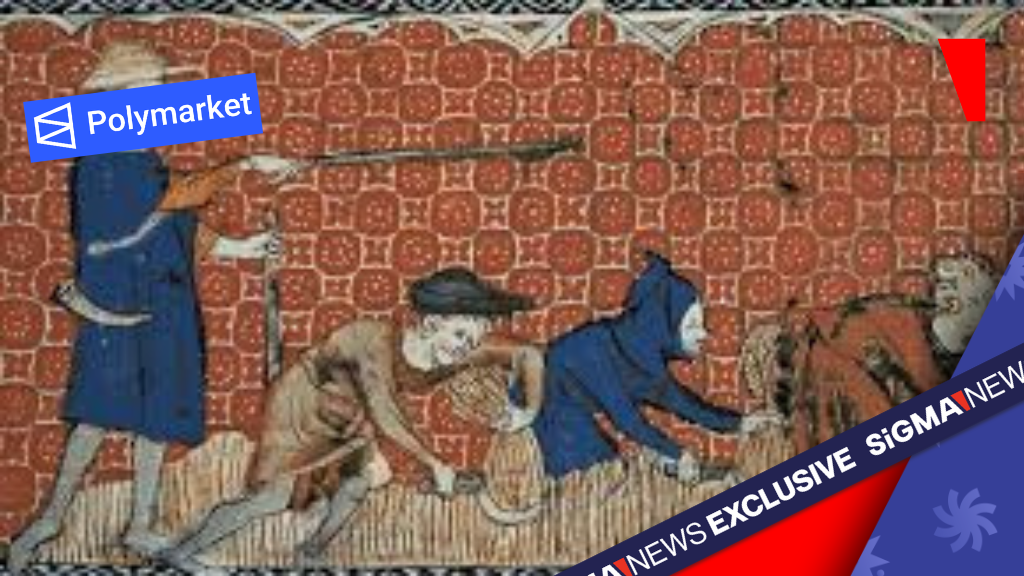
Oh my gosh you guys. It’s here! After a decades-long soft launch in which the general population fell deeper and deeper into inexplicable poverty, Tech Feudalism has finally hard-launched in the form of Polymarket’s free pop-up supermarket. Scrape that bowl of plain pasta into the bin, my friends, for we are saved!
Scrolling through LinkedIn this week, I watched in dystopian disbelief as prediction market platforms announced food bank donations and a free supermarket, like medieval lords distributing grain after a successful harvest. Except the harvest is liquidity, and the castle is a trading platform.
And it isn’t even an online supermarket. It’s a real brick-and-mortar supermarket. Polymarket has signed the lease and everything. Shelves are stocked with 100% free food as a way of giving back to the community that helped build it. As far as I can tell, anyone can walk in and leave with groceries they did not pay for.
Before we continue, it’s important to make it clear that in this context I don’t care whether prediction markets are gambling wrapped in trading wrapped in food banks wrapped in gambling with a little sprinkling of trading. It doesn’t matter now.
Nothing matters anymore.
Welcome to Brand State Economics
Max Barry’s 2003 novel, Jennifer Government, describes a world in which corporations replace nations and people adopt company names as surnames. At the time, it felt like clever satire, a dark joke about late-stage capitalism. But now that companies are getting involved in real-world projects that look suspiciously like social services, it’s not fiction anymore.
So, if a platform profits from users speculating on elections, sports, or economic events, and then uses those profits to fund food security initiatives, what exactly is it? A trading venue. A bookmaker. A charity. A private welfare department. All of the above?
Well, someone had to do something
Platforms that once positioned themselves as just a place to trade are now stepping into spaces traditionally occupied by governments or nonprofits. But what is really fascinating here is that they sit between two completely opposing ideas.
On one hand, the feudalism analogy is obvious. Platforms collect value from massive user bases, concentrate power, and then selectively distribute benefits back to the community. But it’s not taxation. It’s not democracy. It’s generosity, or at least the performance of it.
On the other hand, someone had to do something. The government is too busy trying to annex Greenland so they have somewhere vast and remote enough to bury all the Epstein files. They don’t care about your impending eviction.
So, does it matter where our food comes from if we’re getting it for free? In a world where the majority of people are not getting out what they put in, isn’t it about time that a company flush with liquidity stepped in to help? There is just something about this that feels like more than a standard, cynical marketing campaign.
Would the initiative sit more comfortably if it were started by a company that didn’t have gambling addiction bobbing around in its orbit? Surely Jeff Bezos doesn’t need all of his stuff. Perhaps he could trade his superyacht for one with less helicopter landing pads and use that equity to open a free department store.
This could even set a precedent; you know how competitive these founders get. Maybe in 5 years’ time we won’t have to pay any of our living costs, as long as we join Amazon Prime and trade every week on whether Taylor Swift will be pregnant by the end of the year.
Blurring the line between software and society
Prediction markets are not alone in experimenting with real-world initiatives, but the symbolism here feels sharper because of the industry’s constant identity crisis. These platforms sit at the intersection of finance, gaming, media, and politics. They shape narratives. They influence attention. They monetise uncertainty.
Now they are blurring the line between software and society. Governments provide welfare through taxation. Companies provide perks through marketing budgets. Prediction markets seem to be testing a third model, where redistribution becomes part of brand identity.
That is new territory. The slow death of capitalism territory?
And all of this is happening at a moment when public trust in traditional systems is virtually non-existent. When a private company starts feeding people, it’s not only about whether that’s a good or bad thing; it’s what it reveals about the systems that came before it.
So are we saved?
Of course not, life always finds a way to screw us over.
Maybe this is the beginning of a new kind of corporate citizenship, or maybe it’s just extremely effective marketing. Perhaps it’s both.
Either way, it’s insane. A prediction market that built its reputation on trading probabilities is now handing out free groceries to strangers. Eight hundred years ago, it was grain from a castle; now it’s food from a liquidity pool.
It seems that somewhere between feudal lord and fintech founder, power may be seeking a new interface. In the meantime, I’m going to pop into ‘The Polymarket’ for some free popcorn as I watch this brand new hellscape unfold.
Join the world’s biggest iGaming community with SiGMA’s Top 10 News countdown. Subscribe HERE for weekly updates, insider insights, and exclusive subscriber-only offers.


