


The reform of land-based gaming in Italy: A decisive moment for the sector

The debate on the reform of public gaming in Italy is entering a crucial phase, one that extends well beyond online gaming. Land-based operators, institutional representatives, and major trade associations all agree that the coming months will determine the future of a sector that generates over €12 billion a year in state revenue and provides employment to tens of thousands of people.
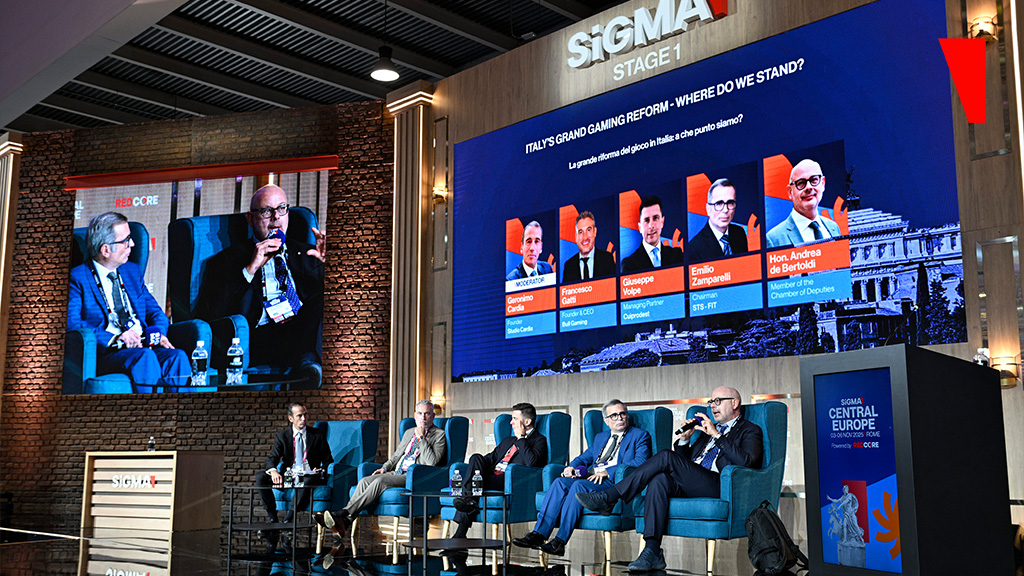
The 2026 Budget Law represents a key milestone: not only for defining new concessions for land-based gaming in Italy, but also for establishing a more balanced model among the State, Regions, and local authorities. But what does the future hold for physical gaming? A panel on Italy’s Grand Gaming Reform, held at the Fiera Roma as part of the SiGMA Central Europe Summit found out.
State, Regions, and Municipalities: Towards Shared Governance
As MP and Member of the Chamber of Deputies of Italy Andrea de Bertoldi reminded the audience at SiGMA Central Europe, the upcoming reform must promote collaboration between different institutional levels, overcoming the regulatory fragmentation that has created uncertainty and inconsistency. From one municipality to another, rules often change — different distance limits, varying time restrictions, and complex licensing procedures.
Involving regions in the distribution of tax revenue would not only ensure greater economic fairness but also shared responsibility in managing gaming and protecting citizens. The goal is to build a cooperative system in which public gaming is recognized as a regulated, monitored, and socially sustainable activity.
Another issue that needs to be addressed is the review of online gaming taxation, which currently differs significantly from that applied to land-based gaming. This imbalance creates internal competition that penalizes the retail network and risks reducing the legal offer in cities.
The Land-Based Network as a Safeguard of Legality
Giuseppe Volpe, Managing Partner at Cuiprodest, highlighted how the physical presence of gaming machines serves as a safeguard of legality across the territory. Each regulated device acts as a state-controlled checkpoint, a barrier against illegal gambling.
Indiscriminately reducing land-based offerings without a clear plan does not decrease gaming activity; instead, it pushes players toward unregulated channels. The belief that fewer machines mean less gambling is not supported by the data. In fact, where the legal offer has been reduced, illegal activity has increased.
Volpe also reminded that public opinion often confuses the pathology of gambling addiction with the normal functioning of the sector. Problem gambling is a real issue that must be managed seriously, but it cannot be the sole parameter guiding gaming policies. True responsibility lies in ensuring a legal, safe, and traceable offer, and not in eliminating it.
Do Restrictions Really Make Gaming Safer?
As Francesco Gatti, Founder and CEO of Bull Gaming and Emilio Zamparelli, Chairman Chairman of STS – FIT pointed out, Italy has introduced several restrictive measures intended to protect vulnerable players – such as the distanziometro (minimum distance requirements) and time limits – but these have often produced the opposite effects.
Moving gaming venues away from populated areas has not reduced the desire to play; it has simply displaced it. Many players have turned to other legal products such as lotteries and scratch cards. Or worse, to illegal gambling.
The economic damage has been significant: reduced tax revenues, job losses, and a weakened legal presence on the ground. Many operators have been forced to shut down or relocate their machines, with serious consequences for the entire supply chain.
Gatti emphasized that by applying a rule meant to protect players, policymakers may have paradoxically exposed them to greater risks.
Finding Balance Between Land-Based and Online Gaming
Another key topic emerging from the debate concerns the need to rebalance the relationship between land-based and online gaming.
On one hand, retail operators are working with outdated machines, taxed “upstream,” under a fiscal framework that fails to reflect technological progress. On the other hand, online gaming continues to grow, supported by lighter taxation and a more modern, flexible offer.
Gatti stressed the importance of updating the operational parameters of new machines: higher payout rates, balanced maximum winnings (between €100 and €200), and technological features such as bonuses and interactive tools – all designed to protect players while keeping the experience engaging, comparable to what online gaming already offers.
He also called for a “transitional measure” to help operators bridge the gap until the renewal of concessions scheduled for 2027–2028, avoiding years of stagnation with non-competitive devices.
The Role of Public Gaming in Local Communities
Emilio Zamparelli reminded that the general retail network, such as bars, tobacconists, and gaming halls, represents the historical backbone of public gaming in Italy. This is where it all began, and it is this very network that now risks disappearing under the weight of restrictive measures.
Land-based gaming is not managed by large corporations, but by small family-run businesses that serve as economic pillars of local communities. Limiting their activities means weakening local economies, removing a safeguard of legality, and taking away a stable source of income.
The proposal, therefore, is to return a portion of gaming tax revenue to local authorities, as happens in other European countries. In Switzerland, for example, gaming revenues are allocated to the cantons for social and cultural purposes. This model could be replicated in Italy, returning value to communities and strengthening the local gaming network.
Highlights
- The 2026 Budget Law will be the turning point for public gaming reform.
- Shared governance between State, Regions, and Municipalities is needed to overcome regulatory fragmentation.
- Land-based gaming concessions will be renewed by the end of next year.
- Public gaming must be recognized as a legal safeguard, not a social problem.
- The distanziometro has pushed gaming toward illegal channels rather than reducing it.
- Gaming machines must be updated to make them safer and more competitive.
- Land-based and online taxation should be harmonized to ensure fair competition.
- The retail gaming network is an economic and social asset that must be preserved.
- Part of gaming revenues could be returned to local communities for social and cultural projects.
- Reforming gaming means strengthening legality, protection, and social responsibility.
Final Quote
“By applying a rule meant to protect the player, we have probably exposed them to greater risks.”
— Francesco Gatti
Disclaimer: The content presented on this page is strictly informational and intended for B2B purposes only. SiGMA Group is not responsible or liable for any business decisions, commercial agreements, or activities conducted by attendees, exhibitors, or third parties during or after the event. All participants are responsible for ensuring compliance with applicable laws and licensing requirements, including those of the Agenzia delle Dogane e dei Monopoli (ADM) in Italy. Our events are restricted to adults aged 18 and over.

